
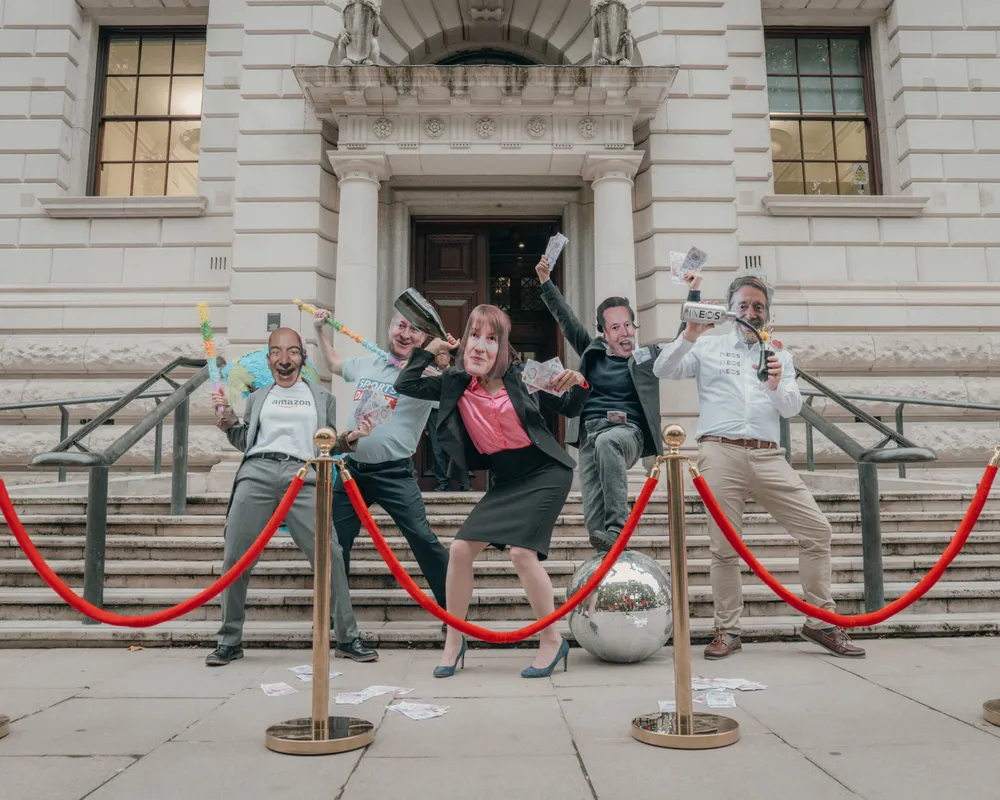
A new report from Oxfam Resisting the Rule of the Rich: Protecting Freedom from Billionaire Power shows billionaire wealth reached $18.3 trillion in 2025, the highest level in human history. That’s more than the GDP of China, the world’s second largest economy. In fact, since 2020, billionaire wealth has increased by 81%.
All of this happens while one in four people don’t regularly have enough to eat, and nearly half the world lives in poverty. Families face rising costs for basics like food, rent, and electricity. Public services are stretched thin. Climate disasters hit harder and more often.
But what is worrying is that this small group holding extreme wealth, isn’t just buying luxury. They are buying control. Political outcomes. And of course, more fossil fuels. Billionaire power is building a dystopian, unliveable world with many government allies helping lock it in. Here is how:
Billionaires are buying democracy, and blocking climate action
Oxfam’s report is clear: extreme wealth doesn’t sit quietly in bank accounts. It gets turned into political control. Alongside getting richer, billionaires are tightening their grip on the institutions meant to serve the public.
The research finds that billionaires are now 4,000 times more likely to hold political office than ordinary people. That imbalance shapes real decisions, deciding what gets funded, what gets blocked, and whose voices are ignored.
And when billionaire political interests dominate, the consequences are brutal and predictable:
- climate action slows, fossil fuel expansion is protected, regulation is weakened, and public money gets funnelled into corporate profit instead of community needs.
- People demanding justice face crackdowns, shrinking civic space, and rising repression.
Oxfam points to the US Trump administration as a warning sign: a pro-billionaire government agenda that slashes taxes for the super-rich, undermines global cooperation to tax corporations, rolls back action on monopoly power, and boosts billionaire portfolios. But this isn’t confined to one country. Oligarchy is going global, and it’s undermining societies everywhere.
And it doesn’t stop at economic policy. Oxfam warns that civil liberties and political rights are being rolled back globally. 2024 marked the nineteenth successive year of decline, with a quarter of countries curtailing freedom of expression. When people protest, governments increasingly respond with violence.
Our bills are going up as their fortunes explode
In 2025, billionaire wealth surged by $2.5 trillion which is what is held by the bottom half of humanity (4.1 billion people). Oxfam estimates this money would be enough to eradicate extreme poverty 26 times over.
At the same time, people are told there’s “no money” for clean energy, resilient infrastructure, or strong public services. Communities are pushed to accept austerity and “tough choices,” while extreme wealth concentrates at record speed.
Oxfam links these choices to real harm: governments slash aid budgets, directly hitting people living in poverty and potentially contributing to more than 14 million additional deaths by 2030.
The result is a world where life feels more unaffordable and more unstable, and where climate action gets treated like an optional extra, instead of a survival plan.
The climate crisis is a business model for the super rich
Billionaire lifestyles are high-emitting, and that matters. But the deeper problem runs through the economic model itself: billionaire wealth is built on extraction and climate plunder.
Many billionaires profit directly from industries tied to pollution and destruction: fossil fuels, mining, deforestation, and corporate land grabs. Their money shapes the political decisions that keep these industries protected, subsidized, and expanding.
And the fallout hits everyone else: higher bills, weaker public systems, polluted air and water, and escalating climate risks. Communities in the Global South and frontline regions pay first and worst while the people most responsible stay insulated from the damage.
They control what we read (and believe)
Billionaire power doesn’t stop at politics. It reaches into the media and the information systems we rely on every day.
The Oxfam report shows how billionaire power doesn’t stop at politics — it spreads into the media and information systems we rely on every day. Billionaires now own more than half of the world’s largest media companies, and they also control all the main social media platforms, giving a tiny group of ultra-rich people enormous influence over what information gets amplified, what gets buried, and how public debate is shaped.
Oxfam points to examples like:
- Jeff Bezos’ purchase of The Washington Post, Elon Musk’s takeover of Twitter/X, and Patrick Soon-Shiong’s ownership of the Los Angeles Times.
- In France, the report highlights how far-right billionaire Vincent Bolloré took control of CNews and reshaped it into a French version of Fox News.
- And in the UK, Oxfam notes that three-quarters of newspaper circulation is controlled by just four super-rich families.
This concentration of media power matters because it doesn’t just influence what people read, it shapes what people believe is possible, normal, or worth fighting for. Oxfam warns that when billionaires dominate media and social platforms, minority voices and dissenting perspectives get pushed out, while scapegoating and disinformation spread more easily. The report points to structural exclusion too: only 27% of top editors globally are women, and just 23% belong to racialized groups, reinforcing whose stories get centered, and whose get ignored.
This also fuels polarization, making it harder to build the public pressure needed for real climate action, and easier for fossil fuel interests to keep operating in plain sight. And while we’re distracted, the fossil fuel machine keeps running.
Oxfam also shows how governments enable this captured information ecosystem. Governments allow billionaire control of platforms to deepen, and in some cases even use these platforms to track, punish, and silence critics. Oxfam points to Kenya, where authorities use X to track, punish, and even abduct and torture government critics. And after Elon Musk’s takeover of Twitter/X, one study found hate speech increased by around 50%, showing how billionaire control over platforms can rapidly reshape what’s normal, visible, and tolerated online.
When billionaires control the narrative, they don’t just defend their wealth, they protect the system that keeps them on top.
The path forward: tax justice, climate justice, people power
The climate crisis demands more than good targets and speeches. It demands a shift in who holds power. Governments need to stop pandering to the ultra-rich and start delivering for people and the planet. That means:
- taxing extreme wealth to reduce its political dominance
- investing in renewable energy, clean transport, social housing, and strong public services
- protecting civic space and the right to organize and protest
- building real firewalls between wealth and politics
People are already pushing for this shift. Across countries, communities are organizing, demanding accountability, and refusing to accept a world run by billionaires and fossil fuel corporations.
Billionaire power is real. But people power is bigger. And when we move together, the future changes.
Related blogs
News, stories, and insights from the global climate movement.
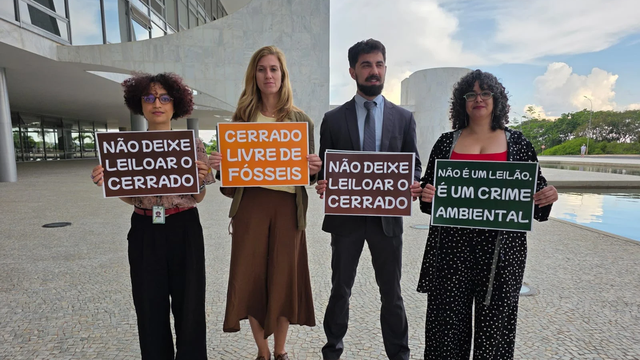
The Cerrado Is Not for Sale
Explore the upcoming gas auction in Brazil and its implications for Indigenous lands and the environment in Maranhão.
Keeping Safe from Fires and Liars
Explore the connection between climate crises and disinformation as experts discuss current challenges and their impacts.
UNGA: A week that laid bare the world’s fault lines, climate crisis all over it
From war to the accelerating climate crisis, this year’s UN General Assembly felt less like a tour through the fault lines shaping the world.
