
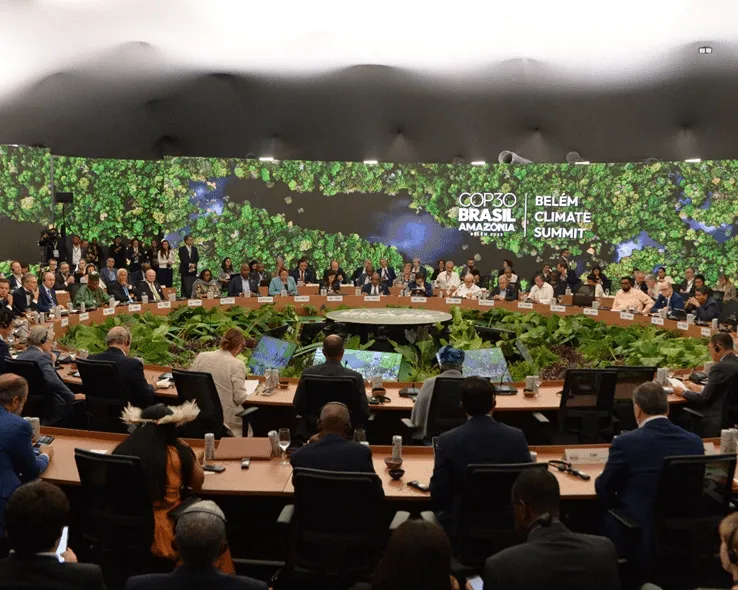
A renewed call for action
Brazil’s President Luiz Inácio Lula da Silva opened the CO30 Leaders Climate Action Summit with conviction stating that: “We can’t wait for others to act — we must lead.”
His words captured the spirit of Belém urgency, courage, and a refusal to accept delay. Lula’s call set the tone for a summit defined by action over rhetoric.
Colombia’s President Gustavo Petro followed with a blunt demand for “zero oil, zero gas.” This landed like a challenge to the world’s addiction to fossil fuels. His message was echoed by Chile’s President Gabriel Boric, who urged countries to “end the hypocrisy of climate promises made while expanding fossil fuel projects.” It was a reminder that credibility in climate politics comes not from speeches. Instead, it comes from shutting down pipelines.
Representing the U.K., Prince William spoke on behalf of the government, urging leaders to act with urgent optimism. He stressed the belief that solutions are still within reach if we act together and without delay. This echoed his message from last year. It was a reminder that even in dark times, courage and collective action can still change the story.
1.5°C is not dead and fossil fuels need to go
Signed in 2015, the Paris Agreement is the world’s landmark accord to limit global warming to 1.5°C. This threshold, scientists say, is critical to avoid the worst impacts of the climate crisis.
Just days before the summit, the UN released its latest Emissions Gap Report. It warned that current national pledges still put the world on track for well above 1.5°C of heating. The timing made Belém a test of political will over a diplomatic stop.
In one of his sharpest speeches yet, UN Secretary-General António Guterres offered hope during in the Summit insisting that the 1.5°C target remains alive, while calling out governments still pouring $1 trillion every year into fossil fuel subsidies on holding back change:
“The United Nations will not give up on the 1.5-degree goal. Too many corporations are making record profits from climate devastation with billions spent on lobbying, deceiving the public and obstructing progress.”
“Last year, 90 per cent of new power capacity came from renewables,” he also said. He noted that a clean energy revolution is underway. “Clean energy is now the cheapest source of new electricity almost everywhere – and creates three times more jobs than fossil fuels.” A fact long backed by research.
The UK government too emphasized that the 1.5 °C target is still within reach. They stressed that progress must not be derailed by defeatism.
Lula joined in, pronouncing that the Earth can no longer sustain humanity’s dependence on fossil fuels, and warned the climate fight could be lost without a rapid transition to cleaner energy.
Calling out bad-faith actors
The Summit also became a stage for frank criticism of climate denial and obstruction. This was a welcome shift toward honesty and accountability.
Colombia’s President Petro didn’t mince words when speaking about U.S. President Donald Trump’s climate denial. He stated, “Mr. Trump is against humanity. His absence here demonstrates that.”
Chile’s President Boric too joined in that frustration. “The president of the United States recently said the climate crisis does not exist. That is a lie. Denying climate science is an insult to the generations that will follow.”
And President Lula went further, without naming Trump directly, warning of “extremist forces that fabricate fake news and condemn future generations to life on a planet altered forever.”
It’s just as well then that the U.S. President skipped the summit. Notably absent too were India, Russia, and China, though China’s vice premier attended in the premier’s stead. The absences said as much as the speeches — a sign of who’s choosing delay over duty.
Still, leadership found another form. Dozens of U.S. subnational leaders stepped up to showcase local climate action. More than 100 state and local officials will travel to COP30. Together, they represent two-thirds of Americans, three-quarters of U.S. GDP, and over half of national emissions. This is proof that momentum is shifting from federal paralysis to local possibility.
A risky turn for the energy transition
Brazil, joined by Japan, Italy, India and others, also announced the Belém 4X Pledge on Sustainable Fuels. This commitment aims to quadruple production and use of “sustainable fuels” by 2035. The fuels named include hydrogen, biogases, biofuels, and e-fuels, following a new International Energy Agency (IEA) report envisioning such an expansion.
While the announcement sounds ambitious, it risks opening the door to false solutions. These risks could deepen inequality and ecological loss rather than strengthen the world’s commitment to a real fossil-fuel phase-out. The World Resources Institute (WRI) has warned that doubling biofuel production could have major implications for food security, land use, and ecosystems. Notably, more than 40 million hectares of cropland are already used globally to grow biofuel feedstocks — an area roughly the size of Paraguay. Without strong safeguards, scaling up biofuels risks triggering new deforestation and land-use pressures. This is particularly true in countries like Brazil, where forests and degraded lands are already under strain.
Multilateralism finds new ground
The COP30 Leaders Segment’s final output was the “Call of Belem for the Climate”“ issued by President Lula for urgent action addressed to all countries. It aimed at giving renewed momentum to the global fight against climate change. The call presents concrete proposals to restore mutual trust. It emphasizes the spirit of collective mobilization for the common good, highlighting multilateralism as the only path to address a global challenge.
The summit also gave space for more open and balanced dialogue — one where smaller nations could speak freely, without being overshadowed. As Barbados Prime Minister Mia Mottley put it:
“The world has never been changed by spectators. It’s time for a coalition of the willing.”
That coalition, spanning island nations, forest protectors, and serious leaders is what now gives multilateralism its pulse. If countries are going to show up to climate talks, let them show up ready to act. They should not just slow progress down.
It’s clear that ambition now comes from those who see the crisis not as a headline. Instead, it is viewed as a lived reality.
If there’s one message from Belém, it’s that multilateralism endures, not in speeches from the biggest economies, but in a new center of climate leadership driven by the Global South, by cooperation over competition, and by a shared belief in climate justice.
As COP30 begins, that’s the note to carry forward: real progress depends not on who has the loudest voice, but on who’s still willing to listen — and act.
Related blogs
News, stories, and insights from the global climate movement.
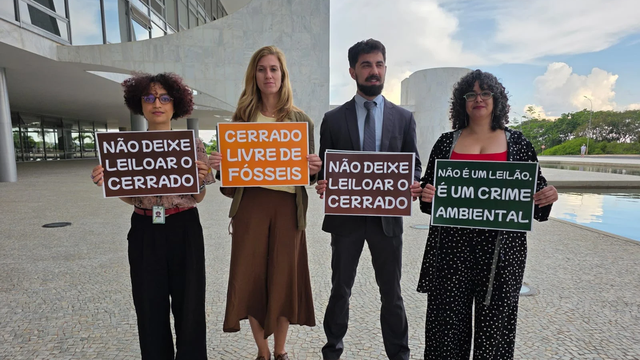
The Cerrado Is Not for Sale
Explore the upcoming gas auction in Brazil and its implications for Indigenous lands and the environment in Maranhão.
Keeping Safe from Fires and Liars
Explore the connection between climate crises and disinformation as experts discuss current challenges and their impacts.
UNGA: A week that laid bare the world’s fault lines, climate crisis all over it
From war to the accelerating climate crisis, this year’s UN General Assembly felt less like a tour through the fault lines shaping the world.
