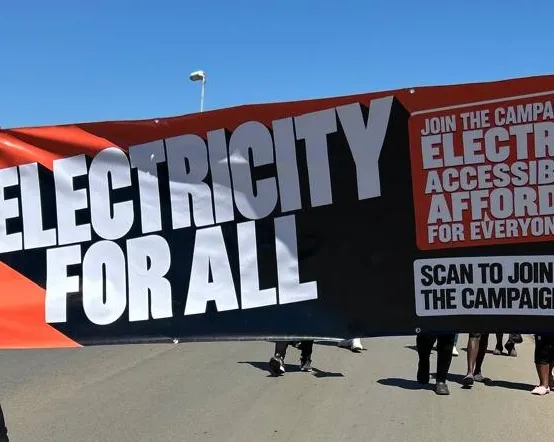
South Africa—Communities across South Africa are mobilising as part of the Electricity For All campaign, with marches, workshops, and community meetings taking place this week to highlight the rising electricity affordability crisis and the difficulties households face in accessing reliable energy. The campaign is calling for 350 kWh of Free Basic Electricity for households that need it and urging government, municipalities, and political parties to prioritise affordable electricity ahead of the 2026 Local Government Elections.
The electricity affordability crisis is not confined to townships or informal settlements. Households across South Africa, including those in suburbs, villages and townships, are feeling the pressure of rising electricity costs alongside a broader cost-of-living crisis, high unemployment and stagnant incomes.
Mduduzi Makhubu of Abahlali Base Zola said:
“The message from communities is clear: people cannot afford to keep paying more for electricity they already struggle to access. We need electricity that people can afford, and political leaders need to listen to what communities are facing and make electricity affordability a priority in these elections.”
The Electricity For All campaign is calling for 350 kWh of Free Basic Electricity, instead of the current 50 kWh allocation, and an end to unfair disconnections, unaffordable reconnection fees, electricity load reduction and the use of smart meters in ways that place additional financial pressure on households.
Electricity tariffs have increased by more than 900% since 2007. More recently, Eskom’s tariffs for direct customers rose by 12.74% in April 2025 and a further 8.76% in April 2026. NERSA has approved another 8.83% increase from April 2027.
For households already struggling to make ends meet, another increase means even less money for food, transport, school costs and other basic needs. The pressure is especially severe in a country where 33.6% of people are unemployed, while the broader measure of labour underutilisation stands at 46.3%, according to the latest Stats SA figures.
With the Local Government Elections taking place on 4 November 2026, communities are putting electricity affordability on the election agenda and calling on political parties and candidates to respond to the realities communities are facing every day.
Cleopatra Shezi, Soweto Electricity Crisis Committee’s energy coordinator, said:
“Unemployed grant recipients receive R370 a month. That money must buy electricity and food, and pay for school transport. It’s unrealistic. Political parties are campaigning for our votes, but will they actually address the struggles of poor South Africans, or is our vote all they care about?”
Government has acknowledged that the current Free Basic Electricity system is failing to reach millions of households. In 2024, Electricity and Energy Minister Kgosientsho Ramokgopa said around 10 million households qualify for FBE, but only about 2 million receive it, citing problems including municipalities’ failure to register indigent households.
Access is only part of the problem. The Department of Electricity and Energy has also acknowledged that the current 50 kWh allocation is insufficient and needs review. Research by the Public Affairs Research Institute (PARI) shows that 50 kWh is far below what households need for basic electricity use, and that 350 kWh a month would provide a more adequate level of access.
Ferron Pedro, Senior Campaigner at 350.org South Africa, said:
“Communities should not have to navigate complicated municipal systems to access support intended for households that need it. Government already recognises that the current 50 kWh allocation is insufficient. We need to see that support reaching the households it is meant for, and we need enough electricity to make a meaningful difference to people’s lives.”
The Electricity For All campaign is calling for:
- 350 kWh of Free Basic Electricity for all households that need it;
- An end to unfair electricity disconnections and load reduction;
- An end to unaffordable reconnection fees;
- An end to practices that exploit households through smart meters;
- Urgent reform to registration processes that reduce access to Free Basic Electricity for households who qualify now; and
- Affordable, reliable electricity that people can actually afford to use.
See the full list of campaign demands in the petition here.
Community actions taking place this week include:
Zola, Soweto — Abahlali Base Zola
Event: Asimali Asibhadali! Community March
Date: Tuesday, 20 October 2026
Time: 10:00 AM
Contact person: Mduduzi 079 272 8864
Meeting point: Zola Engen Garage
Middelburg — Middelburg Environmental Justice Network
Event: Electricity For All Community Meeting
Date: Tuesday, 20 October 2026
Time: 09:00 AM
Contact person: Bafana 076 923 2298
Venue: Christ Centred Ministries (CCM) Church, Mokone Crescent, Ext 1
Qunu, Eastern Cape — Qunu Community Advice Office
Event: Electricity For All Community Meeting
Date: Wednesday, 21 October 2026
Time: 09:00 AM
Contact person: Philiswa 078 211 3171
Venue: Sakhela Great Place
Welkom, Free State — Tshwaraganang Basadi Environmental Justice Network
Event: Electricity For All Community Meeting / Workshop
Date: Wednesday, 21 October 2026
Time: 10:00 AM
Contact person: Mpai 082 535 9543
Venue: Welkom Library
Botshabelo, Free State — Botshabelo Energy Affordability Task Team
Event: Electricity For All Community Assembly
Date: Wednesday, 21 October 2026
Time: 10:00 AM
Contact person: Mooketsi 073 217 9686
Venue: Botshabelo Multifunctional Centre, Section E
Soweto, Johannesburg — United Front
Event: Anti-austerity Electricity For All Rally
Date: Saturday, 24 October 2026
Time: 11:00 AM
Contact person: Nqobile Shezi 072 739 4122
Venue: Pimville Hall
ENDS
For media enquiries, contact:
Boitumelo Masipa
Digital & Communications Specialist
350Africa.org
[email protected]
+27 81 452 9096
Related press releases
Europe’s cost-of-living protests: Crack down on oil profits to fund public services
US inflation rises to 3.7% as energy price shock hits household budgets