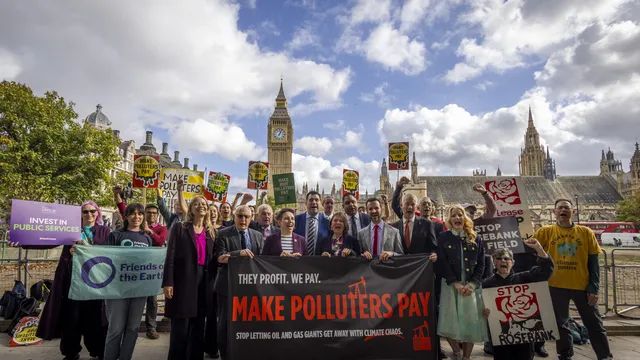
Photos of the action in Colombia available here
Communities and organizations in Mexico, Colombia, Chile, Brazil, and Argentina mobilized in a week of action (October 11 to 17) against a renewed push for fracking in Latin America as some nations seek domestic sources of oil and gas amidst the ongoing Hormuz crisis.
Held weeks before the COP31 climate summit, the region-wide week of action highlights the social and environmental impacts of fracking and demands that governments in Latin America halt expansion and prioritize a transition to clean, affordable renewables.
Organized by the Mexican Alliance Against Fracking, the Colombia Free of Fracking Alliance, and the Latin American Alliance Against Fracking, advocates and communities launched 50 actions – such as marches, concerts, mural making, cultural fairs, public fora – in dozens of cities under the banner #SialaVidaNOalFracking and #FrackingEsColonialismo.
In Colombia, plans are underway to expand Colombia’s extractive frontier as the new right-wing government of Abelardo de la Espriella opens the door to fracking. On Wednesday, anti-fracking activists held an ‘Antifracking in the Park’ Festival and joined massive protests in Bogotá, which were gassed by the police.
Helena Mullenbach, 350.org Latin America Network Coordinator, said:
“The repression we suffered during Wednesday’s protest is just a preview of more suffering that’s yet to come if the government opens Colombia to fracking. They are claiming that fracking can be done in a ‘responsible’ way—this is a lie. It poses a serious threat to water sources by using millions of liters of water and hundreds of chemical additives under high pressure to fracture the rock. The practice also releases large amounts of methane, a devastating greenhouse gas. With the Super Niño on the way, communities’ access to drinking water is already threatened – fracking further puts their lives at risk. While foreign multinationals like Drummond are getting rich in Colombia, it’s the people who are paying the true price. Fracking violates our sovereignty and territories. For real energy independence, Latin American nations must seek to expand homegrown solar and wind power instead.”
Amarilys Llanos Navarro, Colombia Free of Fracking Alliance, said:
“As we stand on the brink of the most intense summer in years, it’s unacceptable that more planet-heating emissions will be released through fracking. Imposing fracking on marginalized regions such as the Magdalena Medio—the epicenter of around half of the country’s seismic activity—deepens the water crisis and puts communities at mortal risk. We demand that the Congress of the Republic bans fracking. We insist on a just energy transition that puts communities at the center.”
Luisa Umaña, energy coordinator for CENSAT Agua Viva in Colombia, said:
“In Colombia, a profound dispute over the direction of energy policy remains unresolved. For decades, dependence on fossil fuels has shaped our economy and government decisions while imposing enormous costs on the regions where they are extracted. Opening up new technological and exploitative frontiers like fracking deepens that dependence just when we need to wean off fossil fuels to address the climate and cost of living crisis.”
Meanwhile, advocates in Brazil warned against moves to authorize hydraulic fracking, as Brazil’s Superior Court of Justice (STJ) on October 14 resumed a landmark trial that will decide the future of fracking in the country.
Joao Cerqueira, Country Manager of 350 Brazil said:
“If fracking is authorized, it will put unique and ecologically sensitive areas of Brazil at risk, endangering traditional communities and Indigenous peoples. At COP30, Brazil showed leadership in the global process to transition away from fossil fuels – it must not abandon the path that it has paved. This dirty and violent form of fossil fuel extraction has no place in Brazil’s energy future, especially as cleaner renewable energy sources abound.”
In Mexico, the government is preparing to tap more shale oil and gas reserves using fracking, deeming it as necessary to ease the country’s dependence on US fossil imports. On October 17, protesters will march in Mexico City against Pemex, the country’s state-owned petroleum company.
Alejandra Jiménez Ramírez, Mexican Alliance Against Fracking, said:
“In Mexico, fracking has wreaked havoc on communities for more than two decades. To date, 41 fracking wells have been drilled in unconventional reservoirs and more than 8,000 in conventional reservoirs. The impacts are grim: water sources, people’s health and over-all quality of life have deteriorated in the areas where fracking has occurred, alongside human rights violations. In addition to being ecocidal, fracking is also extremely costly.”
In Argentina, fracking has been underway since 2013, but groups warn that it is not a model for the region, but a warning sign to heed.
Fernando Cabrera, a researcher at the Observatorio Petrolero Sur in Argentia said:
“Thirteen years after the first wells began production, the success of fracking in Vaca Muerta is presented as a model for other countries in the region to follow. But little is reported about the fact that the country is going through one of its worst environmental crises due to fracking. One of Argentina’s most important watersheds is at risk. More than 500 earthquakes have already been recorded in an area that previously didn’t experience seismic activity. The management of the millions of metric tons of toxic waste generated by this activity remains unresolved. This is the logic of the system: corporations profit, while the country and its people lose out.”
Photos of the action in Colombia available here
Press contacts:
Alfonso Cañon. Alianza Colombia Libre de Fracking. +573194067968
Helena Mullenbach. 350 Latin America. +573143024914
Alejandra Jimenez. Mexican Alliance Against Fracking. +527841176209
Angela Henao. CENSAT Agua Viva +573004416074
Related press releases
US inflation rises to 3.7% as energy price shock hits household budgets
Climate damage from Indonesia’s wildfires needs cooperation