Taking That First Step Together
In the Republic of the Union of Myanmar, a group was formed with like-minded people interested in helping the environment,...
60 Leaders. 20 Cities and Provinces. 1 Shared Belief
Over 60 enthusiastic participants attended I AM A CLIMATE CITIZEN, a national workshop for young leaders acting on climate change....
The Science
“If humanity wishes to preserve a planet similar to that on which civilization developed and to which life on Earth...
A Guide to Personal Divestment
The fossil fuel divestment movement is sweeping the nation. This grass roots campaign is now branching into the collective power of individual statements of personal divestment. This is your chance to speak with conviction about the world you would like to invest in by divesting your funds from fossil fuels.
We recognize that personal divestment is both a responsibility and a privilege. Many of us don't have retirement accounts or other investment market funds to divest. But for those of us that do, removing our financial stake in the companies driving the climate crisis is our responsibility.
March Across Country For Climate Action

Zach Heffernen works with the Great March for Climate Action and he wrote this blog to let us know about their big plans.
Beginning on March 1, 2014, a determined group of people will begin an 8-month, 3000-mile trek across the nation. The goal is to create the largest coast-to-coast march in American history to motivate society to act now to address the climate crisis. Individuals who have signed-up to march so far range in age from 9-82, come from all over North America, and include college students, business professionals, activists, retirees and everything in between.
The March will start in Los Angeles on March 1, 2014, and pass through Phoenix, Denver, Omaha, Chicago, & Pittsburgh and conclude in Washington, DC on November 1. Marchers will walk 14-15 miles per day and camp nearly every night. Educational activities will be conducted along the March to inspire climate action within local communities.
Bill McKibben endorsed the March, saying, “350.org was born in a march of a thousand people across Vermont; it always does our hearts good to see others on the move!”
“Given the early interest, we are confident there are well over 1,000 people ready to make the commitment to march across America for this cause,” says Ed Fallon, the founder and director of the march. “Not only will we march side by side for eight months, but we’ll learn how to live together, work together, and communicate the urgency of our message to the people we meet as we travel across the country.
Want to march with us or learn more? Check out climatemarch.org.
What does the Carbon Bubble mean for Canada and the tar sands?
It’s hard to know when a once radical idea goes mainstream, but we’re probably at that point with the carbon bubble. If you’re unfamiliar with the term here’s a quick definition. Basically, the carbon bubble is the idea that fossil fuel companies are overvalued because if and when the world ever gets serious about dealing with the climate crisis, the fossil fuel companies won’t be able to burn their carbon reserves, from which they derive their value.
Bill McKibben wrote about this idea last year in Rolling Stone, in an article that went strangely viral. In fact, the article got more hits than the Justin Bieber profile that appeared in the same edition of the magazine. Clearly this idea is hitting a nerve.
It’s not just environmentalists that are pushing this idea. The World Bank, London School of Economics and the International Energy Agency--all not exactly hippie outfits-- have put out warnings about a carbon budget, the upper limit of how much carbon we can burn and have a reasonable chance of not raising global temperatures more than 2 degrees C, a target that every country, including Canada, has agreed is the red line that we shouldn’t cross.
The carbon budget creates the carbon bubble. The idea of carbon budget received a boost a few weeks back when the Intergovernmental Panel on Climate Change (IPCC) sounded the alarm for immediate action on climate change and the necessity for keeping much of known fossil fuel reserves in the ground. The IPCC is made up of 2,000 of the top climate scientists in the world. If they say there is a budget, we ought to listen.
The budget is about 565 gigatons of CO2 (A gigaton is a billion tons). That sounds like a lot, and it is. The problem is we are blowing through about 31GtCO2 a year, meaning we will spend our budget in about 15-25 years.
Here’s where Canada and the tar sands come in. Calculations performed by 350.org, using industry filings and commonly accepted carbon accounting, show that the tar sands industry’s 170 billion barrels of economically viable proven reserves are estimated to take up about 17 percent of the world’s remaining carbon budget, or about 1/6 of what we have left to burn.
When you stop to think about it, that’s a big, big problem for Canada, the financial markets, and the world’s climate system. For Canada, it means that an over-reliance on the tar sands as an economic drive is a huge risk if the world ever regulates greenhouse gas emissions. It doesn’t make a ton of sense to build your economy around a product that can’t be sold or used.
For the markets, it means that companies that are heavily invested in the tar sands could be hugely over-valued, and therefor an existential threat to the economy. Suncor, TransCanada, and Shell are all betting big, along with Harper, that the world will never deal with the climate crisis. That’a a bad bet if you care about the stability of the markets.
And for the world, there must be a reckoning between physics and business as usual. Physics, who is undefeated to date, is telling us that we can only burn so much carbon and stay below our safe limit. Business as usual, championed by global conglomerates like Exxon and Chevron, are banking on us not getting serious about saving the planet.
Who will win just might determine the fate of the climate--and our economy.
Our Annual Report
[tabs] [tab target=”letter”]Letter[/tab][tab target=”highlights”]2012 Highlights[/tab][tab target=”financials”]Financial Information[/tab][tab name=”letter”] Dear friends and supporters, 2012 shocked the climate movement and 350.org into...
Bushfires Raging in Spring. Something is up.
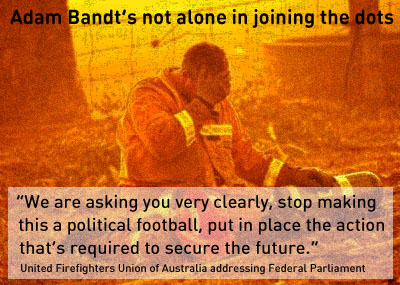
Bushfires are raging across the state of New South Wales in Australia. It's only Spring. Something is up. Yesterday, the Greens Member of Parliament, Adam Bandt, made headlines by suggesting that climate change is connected with the deadly NSW bushfires, which are causing widespread destruction. It has been treated as if he was speaking like a radical - by the media and by deniers. But there is nothing radical about what Bandt said - it’s what the Bureau of Meteorology have said and it’s what the Firefighters Union have said when addressing Parliamentarians:
"We are asking you very clearly, stop making this a political football, put in place the action that's required to secure the future because by 2020 we are going to see a frequency like we've not seen before." -- United Firefighters Union of Australia
It’s deeply worrying that, here in Australia, the causes and impacts of climate change have remained a political football. The increasing frequency and severity of bushfires show us that we can't hide from climate change impacts - they are happening already - not just here but all over the world. From the melting of the Arctic, larger cyclones hitting the Philippines, wildfires and drought in the United States, the list goes on. We’re entering a new era of weather extremes and it has a deadly toll.
How can any of us watch, be affected and not be frightened about what climate change means for all of us in Australia? We can't bury our heads in the sand -- we need to face what we're up against and insist on political action to reduce our emissions and avoid further community devastation. Bushfires aren't political, but we need political action to stop them.
What can we do?
1. Talk about it! It's a real concern and we need to talk to our politicians (pick up the phone and call your MPs and Senators), your local paper or radio station, your community and neighbours. Don't let deniers stop you voicing your concerns about the climate impacts we face nor the action needed to address them!
Suggested Tweets:
- Wildfires in October? Let's connect the dots: #climate change is driving extreme weather and wildfires. @TonyAbbottMHR @SMH @abcnews
- @SMH @abcnews We need to be talking about the link between climate change, wildfires and action to reduce emissions
- I stand with @AdamBandt and Firefighters: Message to @TonyAbbottMHR stop making #climate change a political football, make it about action.
- My sympathy goes out to all impacted by NSW bushfires. Let’s take action on #climate change seriously so fires don’t get even more wild.
Share this image on Facebook by clicking here or on the image.
2. Divest! If we are to avoid further extreme weather impacts, it’s time to take away the power of the industry that’s driving these impacts. By moving our money out of fossil fuels, we can start to erode the industry’s social license and motivate the political action our climate so desperately needs. Find out how you can start moving your money today!
It’s time to show that this isn’t just about something a Greens Parliamentarian feels strongly about, but it is an issue and a real challenge that we all face. If last summer was anything to go by, the coming summer won't be pretty - it’s time to talk and it’s time to act.
Our heartfelt sympathies go out to all those impacted by the bushfires. In writing this, we are not seeking to make your suffering a political opportunity, rather a chance to call for action so that further suffering may be avoided.
First Nation Fracking Protest Escalates in New Brunswick

Our allies in Canada have urged us to spread the word about an important fossil fuel resistance effort underway in the town of Rexton, in New Brunswick, happening now. New Brunswick is one of the largest geographic areas under consideration for expanded fracking. For more information about Shale Gas drilling in New Brunswick, click here.
A group First Nations protestors and their allies gathered in the region to confront expanded shale-gas drilling, beginning on Sept 30, according to the Canadian Broadcasting Company.
Please help spread the word about this as a way to support our allies. Here is a livestream to follow updates.
Global Frackdown

We are nearly a week into Reclaim Power — a global month of action on energy. The next big day to come up is this year's Global Frackdown, a day when communities around the world are uniting to demand a shift to clean, renewable energy and debunk the myth of shale gas as bridge fuel.
Click here to find events planned near you.
To help get the word out in the coming days, there is a whole set of social media resources to help make it easy to spread the word online here: https://www.globalfrackdown.org/social-media
And here's a clip of 350.org co-founder Bill McKibben joining in the call to action for this Saturday: