The “Big 4” Australian Banks are Financing the Destruction of the Great Barrier Reef
A new report released today by Market Forces and 350.org Australia shows how Australia’s ‘big four’ banks, supported by international investors, are literally Financing Reef Destruction.
The report makes it clear that the ‘big four’ Australian banks – ANZ, Commonwealth, NAB and Westpac – play a critical role in enabling major fossil fuel projects. Combined, these banks lent $3.8 billion to coal ports and LNG terminals in the Great Barrier Reef Word Heritage Area since January 2008.
Australia’s Great Barrier Reef literally sits in the way of the fossil fuel industry and its massive expansion plans. Of the many new coal terminals planned just one port, Abbot Point, near Mackay, could increase almost nine-fold in capacity to become by far the biggest coal export port ever in the world.

350.org Australia and Market Forces are calling on customers of those banks to tell them to stop financing reef destruction or they will pull out their funds and go elsewhere.
Bill McKibben, coming to Australia in June for a “Global Warming: Do the Maths” tour, said “When you do the maths on avoiding the worst impacts of climate change, there simply isn’t enough room in the carbon budget for new fossil fuel projects.
“We’ve got to wind down the fossil fuel era with great haste if we’re going to keep the planet from overheating,” McKibben said. “This report provides Australians with the information they need to make hard decisions about where their money is invested and if it’s helping or destroying the planet.”
How Divestment Happens: The Inside Story from the Uniting Church of NSW & ACT
Just over a week ago here in Australia, the Uniting Church of New South Wales and ACT made the bold pledge to divest it's investment funds from the fossil fuel industry, directing them into renewable energy instead. It made headlines, and is the start of a coming wave of divestment campaigning in Australia. Justin Whelan, Mission Development Manager at Paddington Uniting Church explains how they got the Church Synod to make the decision - and one that was made by consensus!
There is an etiquette in the church that we don't clap resolutions when they pass, but this time excitement got the better of too many people. A wave of applause broke out. Was it only in this moment that people realised the significance of what we had done? Or was this the bursting dam, a community waiting a long time for a little nudge to help them be the radical, prophetic people they want to be?

For those of us who brought the divestment proposal to the 400-member council meeting (known as a 'Synod meeting') of the Uniting Church in New South Wales and the ACT, there was relief to go with the excitement. We had been negotiating with key leaders over the first three days of the meeting, soothing concerns and making small amendments as needed. The ethical investment managers had legitimate operational concerns, and by working with them they were addressed.
Another key leader, whom we had pegged as an ally, told us he would oppose it in the strongest terms. A long conversation ensued about theories of social change and comparisons with other campaigns he is passionate about. At the time we thought we hadn't convinced him but when the public debate came, he too supported the resolution with a minor change: he wanted to add to the decision!
So now we have committed to investing in renewable energy instead of fossil fuels, and a communications strategy will be devised by 'head office' staff to encourage and support individual members taking their own action, such as moving their superannuation (pension) funds to ethical investors.
All this by consensus. Our church’s decision making process was a potential problem but in the end we need not have feared. This proposal followed a string of resolutions about the environment and climate change over the last two decades. The church has been an outspoken advocate for climate action for at least ten years. At the same meeting we heard from farming communities being ‘fractured’ by the coal seam gas industry, and passed a resolution calling for the protection of valuable land and water resources. The divestment proposal was both an effective way to dramatically ramp up that advocacy, as well as putting our money where our mouth is. In this context, “we refuse to profit from destroying the earth” was a pretty easy message to sell.
If anyone was in doubt about the significance of the Synod's decision, the media interest will have set them right pretty quickly. With nothing more than a media release, our resolution achieved national print and radio news coverage, a string of interviews and a social media storm (thanks 350.org for helping with that!). One journalist asked me whether I really thought this would have any impact - whether anyone would care what the church does with its money. I felt like saying "well, you called me, didn't you?"
There are still questions of implementation for the investment managers to consider, and we are starting to get some backlash from coal mining companies that give grants to church-run community services. In Australia, the resource sector is so significant to the economy that it was inevitable that even churches find themselves enmeshed in it. These are challenges we all face as communities living in the world as it is now. These are challenges we must all face head-on if we are to avoid catastrophic climate change.
The Uniting Church in NSW-ACT has had an ethical investment policy for about 30 years, making it something of a world leader in that regard. We already refuse to invest in the tobacco, armaments, uranium mining and gambling industries, as well as companies with poor records on human rights, working conditions, and so on.
Now fossil fuel companies have been added to that list. For some this link to other toxic industries was a cognitive breakthrough: we weren't saying they were 'bad' companies, we were saying their once vital business has become a threat to human and ecological life.
As Bill McKibben says, and we emphasised, "there is no flaw in their business plan. The flaw is their business plan."
Justin Whelan, from the Uniting Earthweb Group
You can read more about the church’s divestment decision here.
Get Ready for the Australian Coal Show-Down
While the momentum of the Fossil Fuel Resistance Movement has grown from strength to strength across the United States, it's worth noting that a similar sort of momentum is now brewing across Australia.
Just four months into the year and we’ve already seen many climate wins here.
In Newcastle activists successfully stopped the expansion of the world’s largest coal port, in WA plans to build a gas hub on James Price Point were withdrawn and companies have been pulling out of coal seam gas operations across New South Wales.
There’s been even more this month. Just last week the Uniting Church of New South Wales and ACT announced it was divesting from the fossil fuel industry and in the middle of the month the small town of Bulga in the Hunter Valley won its court appeal to block a new coal mine. On Wednesday six Greenpeace activists climbed aboard a coal ship on the way to South Korea to demand a stop to our coal exports.
There's a fantastic groundswell building, and now through Bill McKibben’s Do the Maths Australia tour in June, we’ll be launching a new wave of campaigning to divest Australia from the coal industry, and to do our part to bring on the global age of renewable energy. Naturally, this has started to get the coal industry worried.
On Wednesday the Australian Coal Association, writing in The Australian, took aim at 350.org and Bill McKibben, saying “Foreigners coming to Australia to campaign against our national economy can do a lot of damage if their claims go unchallenged.”
They also said a lot of other self-inflating and misleading things in that article. One thing's for sure: in the coming months they will be working their spin doctors hard. We’ve got a fight on our hands, and we need to be one step ahead.
350.org Australia is throwing everything we’ve got into this fight, and so we're reaching out for help now. Can you help us ensure Bill McKibben's Do the Maths tour helps wake Australia up to the battle we are facing -- taking on the fossil fuel industry to ensure we all have a safe climate future?
Chip in now to our Start Some Good campaign here, which will enable us to rise to the challenge.

Let's get ready.
Let us count the many ways Joe Nocera is wrong on Keystone XL
Joe Nocera of the New York Times is back with another column in support of Keystone XL. I counted 4 errors or willful oversights in Nocera's piece, although I'm sure I missed some. Let's review.
1. Speaking about KXL's importance: "Energy independence is a long-sought national goal. We would no longer need OPEC, a cartel of countries with values, in many cases, antithetical to ours."
First, it remains unclear how "energy independence" can be achieved by continuing our reliance on fossil fuels and the corporations that supply them. Exxon made $45 billion last year; its CEO Rex Tillerson made $100,000 a day by supplying our fossil fuel addiction. If Joe wants to keep lining their pockets and strengthening their grip over our democracy that's his deal, but you can't argue in favor of independence if you want to keep a supplier from whom you can't shake loose. Second, no one that I know of seriously thinks that the Keystone XL export pipeline would lead to us no longer needing OPEC. The only way to do that is to drop Big Oil and petro states once and for all. And the only way to do that is to get serious about green energy, which Nocera treats like a punch line. I wonder if they are laughing in Iowa now that they are getting 25% of their electricity from wind?
2. "That oil is coming here anyway -- by rail and boat, where spills are common, and via pipelines that are older, and hence less safe, than Keystone would be."
On spills, one word: Arkansas. Oh, and every major export pipeline in Canada is under heavy scrutiny and suffers from huge public opposition. Even under the most rosy scenarios, none of these pipelines will be built any time soon. In fact, Alberta is so nervous about the pipeline proposals being blocked that it recently started looking into the possibility of exporting oil all the way up at the port at Tuktoyaktuk, N.W.T., a.k.a way the heck up there. On the rail question, Canadian Natural Resources Minister Joe Oliver told Reuters yesterday, "It (rail) is a good supplement but not the longer-term solution...I don't think anybody would suggest it is." He doesn't know Joe Nocera!
3. "Notwithstanding the development of alternative energy sources, the world is going to continue to need oil; Oliver, quoting the International Energy Agency, says that global energy demand is expected to grow by at least 35 percent over the next 20 years."
Nope, enviros don't think that pixie dust will fuel our cars any time soon. But the US is using less oil this year than we did last year, and less oil last year than the year before that. The question is do we want to lock in 40-50 years of oil addiction with Keystone or get serious about dropping fossil fuels once and for all?
Also, while Nocera quotes from the IEA, he neglects to mention that the IEA also said that we need to leave a full 2/3s of known fossil fuel reserves in the ground if we are to avoid runaway climate change. It would be funny how he leaves that part out of IEA's findings if climate change was funny at all.
4. "The notion, pushed by environmentalists, that blocking the oil sands will spur green energy is delusion."
Nope, don't know anyone who says that. Not a one. Think that's called a straw man argument. Anyway, what enviros say is that committing to more oil reduces incentives to invest in green energy. I think it's called supply and demand. Not sure, but Nocera is a business columnist. Maybe he can tell me.
Ten U.S. Cities Now On Board with Fossil Fuel Divestment!
We’re excited to announce today that ten U.S. cities are now on board with fossil fuel divestment! They include: Seattle, WA, San Francisco, CA, Berkeley, CA, Richmond, CA, Boulder, CO, Bayfield, WI, Madison, WI, State College, PA, Eugene, OR, and Ithaca, NY.

Say it ain’t so, Joe. A reality check on Joe Oliver and tar sands development
 Canadian Natural Resources Minister Joe Oliver is in Washington this week to lobby on behalf of the tar sands industry. Today he addressed the Center for Strategic and International Studies and in his remarks he greatly embellished or misrepresented both Alberta’s and Canada’s record on climate change while downplaying the impacts from increased tar sands development. Below are exact quotes from Oliver, followed by a Reality Check.
Oliver: “Large producers in Alberta pay a per ton fee into a technology fund that invests in research and development to reduce GHG emissions.”
Reality Check: Alberta’s current policy costs the tar sands industry less than 10 cents a barrel. There are rumors of a new plan, the so called 40/40 plan (a 40% reduction in per-barrel emissions from tar sands and a $40-per-ton payment when that emissions limit is exceeded), but no plan has yet surfaced. Under 40/40, the cost for the tar sands industry to comply would be about the cost of a Coca-Cola at a 7-11 (under $1.50 for a barrel of tar sands oil).
Oliver: “Together with the province of Alberta, we are implementing a new, world-class environmental monitoring system for the oil sands. It will provide independent, science-based environmental reporting, founded on partnership with industry, Aboriginal communities and other levels of government.”
Reality Check: That’s true but Oliver left out that the system won’t be fully implemented until 2015, yet the government wants to approve major infrastructure projects now which would lock in pollution regardless of what the monitoring system finds later. A very useful timeline from Greenpeace on the history of this monitoring system is available here.
Oliver: “In the past year, we have implemented a new, national strategy for responsible resource development — a regulatory regime that offers both a more efficient and predictable process for investors and enhanced protection for Canada's environment.”
Reality Check: It’s hard to call Canada’s policy to develop the third largest pool of carbon on the planet “responsible.” Canada is on track for a 7% increase in emissions by 2020. Tar sands emissions have more than doubled since 1990 and are expected to triple between now and 2020. The IEA has said to avoid runaway climate change Canada will need to keep a full third of its tar sands underground, yet Oliver is championing policies to get at what he estimates to be 300 billion barrels of tar sands crude found in Alberta. Additionally, investing in oil development is no longer a safe bet. The Carbon Tracker Initiative and the London School of Economics recently released a report that shows that 60 to 80 percent of coal, oil and gas reserves held by the top 200 oil, gas and mining companies listed on the world’s stock exchanges could be considered unburnable.
Oliver: “Before I touch on the jobs and economic benefits I think it is important to recall that the U.S. State Department, which is the lead Department on this issue, concluded that the Keystone XL pipeline would not have a significant impact on the environment.”
Reality Check: The US EPA on Monday graded the State department's Keystone XL analysis as “insufficient.” EPA has asked State to look again at the climate impacts of the pipeline; Keystone’s route through the Ogallala Aquifer; and the department’s market analysis of transporting tar sands crude via rail. On all of these questions and more, State failed its test. State's SEIS has come under such significant criticism that it can no longer be taken seriously as an accurate evaluation of Keystone XL.
Oliver: “Furthermore, Canadian oil would come in by train. And, of course, Canada would export oil elsewhere.”
Reality Check: Every major export pipeline in Canada is under heavy scrutiny and suffers from huge public opposition. Even under the most rosy scenarios, none of these pipelines will be built any time soon. In fact, Alberta is so nervous about the pipeline prosals being blocked that it recently started looking into the possibility of exporting oil all the way up at the port at Tuktoyaktuk, N.W.T., a.k.a way the heck up there. On the rail question, a few hours after making these comments, Oliver himself refuted them, telling Reuters, "It (rail) is a good supplement but not the longer-term solution...I don't think anybody would suggest it is." This is due to the high cost of rail, which some industry analysts estimate is as high as $30 per barrel.
What it was maybe like in Nebraska during the Keystone XL hearing (video)
Last Thursday, braving heavy snow and wind, hundreds of commited citizens lined up to testify at the lone public hearing on the Keystone XL tar sands pipeline. By most estimates, it was 9 to 1 against the pipeline, and administrators of the hearing had to stay late into the night to hear everyone’s testimony.
Nebraska has always been ground zero for opposition to the pipeline. Keystone, if built, would go through the Olagalla Aquifer and Nebraska’s sensitive Sand Hills, putting each at risk. Ranchers and farmers, some of whom have been on their land for generations, see the pipeline as an existential threat, and they’re not shy about telling anyone, at anytime, that they don’t want this pipeline.
President Obama heard their voices when he denied the permit for Keystone two years ago. It remains to be seen if he will listen this time, but there’s little doubt that the voices of Nebraskans ought to sound louder to the president than those of TransCanada, the company behind KXL. This was what he said in 2011:
“Folks in Nebraska like all across the country aren’t going to say to themselves, ‘We’ll take a few thousand jobs if it means our kids are potentially drinking water that would damage their health. We don’t want, for example, aquifers to be adversely affected. Folks in Nebraska obviously would be directly impacted.”
If you missed the hearing, here’s a beautiful video that captures some of what it must have been like to be there. Please pass it on.
San Francisco Board of Supervisors Unanimously Pass Resolution Urging Fossil Fuel Divestment!
Exciting news! The San Francisco Board of Supervisors just voted unanimously to support fossil fuel divestment. Here's a press release we just put out:
1 million comments to stop Keystone XL!
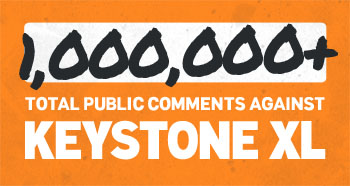
Success! In just 45 days, the movement to stop Keystone XL submitted over 1 million comments to oppose the pipeline to the State Department!
We set this goal knowing it was a stretch, and we reached it on the final day of what turned into a comment-sprint to the finish. This shows the breadth and depth of opposition to the pipeline, and provides a clear mandate for President Obama to reject the pipeline.
And the pressure appears to be working: the same day as we submitted our 1 millionth comment, the US Environmental Protection Agency rated the State Dept.'s pipeline review 'insufficient,' pointing out that Keystone XL would be more toxic and have a bigger climate impact than described by State.
Thank you to everyone who submitted, shared and organized to stop the pipeline -- let's keep rolling!
The full press release is below:
#EarthNight
Friends,
On Sunday, April 21st -- what we’re calling “Earth Night” -- 350.org will premiere a film about our work and our growing movement.
It features the big tour we did across the country last fall, and so the film is also called “Do the Math.” The trailer for the movie was just released a few minutes ago -- check it out:

On the night of April 21st, people will gather in hundreds of living rooms and libraries across the country for the premiere of the movie. Meeting in person is the lifeblood of our movement, and we hope that gathering to watch this snazzy film can be an opportunity to connect with new people and grow the movement locally.
I’ve already had a chance to preview the movie; it is an inspiring, beautiful, and fast-paced story that shows the power of the growing climate movement. It clocks in at 42-minutes -- and it packs a lot in: from the cross-country tour we did last year, to the latest dispatches from leaders in the fight to stop Keystone XL, to the campaign to divest from fossil fuels.
We also have a page that answers a lot of questions you might have about the movie -- check it out here: www.350.org/math
Onwards,
Anna for the whole 350.org team
P.S. April 21st is one day before the end of the State Department's public comment period on the Keystone XL pipeline -- so we'll make sure folks can collect and submit comments at local events.