A Guide to Personal Divestment
The fossil fuel divestment movement is sweeping the nation. This grass roots campaign is now branching into the collective power of individual statements of personal divestment. This is your chance to speak with conviction about the world you would like to invest in by divesting your funds from fossil fuels.
We recognize that personal divestment is both a responsibility and a privilege. Many of us don't have retirement accounts or other investment market funds to divest. But for those of us that do, removing our financial stake in the companies driving the climate crisis is our responsibility.
March Across Country For Climate Action

Zach Heffernen works with the Great March for Climate Action and he wrote this blog to let us know about their big plans.
Beginning on March 1, 2014, a determined group of people will begin an 8-month, 3000-mile trek across the nation. The goal is to create the largest coast-to-coast march in American history to motivate society to act now to address the climate crisis. Individuals who have signed-up to march so far range in age from 9-82, come from all over North America, and include college students, business professionals, activists, retirees and everything in between.
The March will start in Los Angeles on March 1, 2014, and pass through Phoenix, Denver, Omaha, Chicago, & Pittsburgh and conclude in Washington, DC on November 1. Marchers will walk 14-15 miles per day and camp nearly every night. Educational activities will be conducted along the March to inspire climate action within local communities.
Bill McKibben endorsed the March, saying, “350.org was born in a march of a thousand people across Vermont; it always does our hearts good to see others on the move!”
“Given the early interest, we are confident there are well over 1,000 people ready to make the commitment to march across America for this cause,” says Ed Fallon, the founder and director of the march. “Not only will we march side by side for eight months, but we’ll learn how to live together, work together, and communicate the urgency of our message to the people we meet as we travel across the country.
Want to march with us or learn more? Check out climatemarch.org.
What does the Carbon Bubble mean for Canada and the tar sands?
It’s hard to know when a once radical idea goes mainstream, but we’re probably at that point with the carbon bubble. If you’re unfamiliar with the term here’s a quick definition. Basically, the carbon bubble is the idea that fossil fuel companies are overvalued because if and when the world ever gets serious about dealing with the climate crisis, the fossil fuel companies won’t be able to burn their carbon reserves, from which they derive their value.
Bill McKibben wrote about this idea last year in Rolling Stone, in an article that went strangely viral. In fact, the article got more hits than the Justin Bieber profile that appeared in the same edition of the magazine. Clearly this idea is hitting a nerve.
It’s not just environmentalists that are pushing this idea. The World Bank, London School of Economics and the International Energy Agency--all not exactly hippie outfits-- have put out warnings about a carbon budget, the upper limit of how much carbon we can burn and have a reasonable chance of not raising global temperatures more than 2 degrees C, a target that every country, including Canada, has agreed is the red line that we shouldn’t cross.
The carbon budget creates the carbon bubble. The idea of carbon budget received a boost a few weeks back when the Intergovernmental Panel on Climate Change (IPCC) sounded the alarm for immediate action on climate change and the necessity for keeping much of known fossil fuel reserves in the ground. The IPCC is made up of 2,000 of the top climate scientists in the world. If they say there is a budget, we ought to listen.
The budget is about 565 gigatons of CO2 (A gigaton is a billion tons). That sounds like a lot, and it is. The problem is we are blowing through about 31GtCO2 a year, meaning we will spend our budget in about 15-25 years.
Here’s where Canada and the tar sands come in. Calculations performed by 350.org, using industry filings and commonly accepted carbon accounting, show that the tar sands industry’s 170 billion barrels of economically viable proven reserves are estimated to take up about 17 percent of the world’s remaining carbon budget, or about 1/6 of what we have left to burn.
When you stop to think about it, that’s a big, big problem for Canada, the financial markets, and the world’s climate system. For Canada, it means that an over-reliance on the tar sands as an economic drive is a huge risk if the world ever regulates greenhouse gas emissions. It doesn’t make a ton of sense to build your economy around a product that can’t be sold or used.
For the markets, it means that companies that are heavily invested in the tar sands could be hugely over-valued, and therefor an existential threat to the economy. Suncor, TransCanada, and Shell are all betting big, along with Harper, that the world will never deal with the climate crisis. That’a a bad bet if you care about the stability of the markets.
And for the world, there must be a reckoning between physics and business as usual. Physics, who is undefeated to date, is telling us that we can only burn so much carbon and stay below our safe limit. Business as usual, championed by global conglomerates like Exxon and Chevron, are banking on us not getting serious about saving the planet.
Who will win just might determine the fate of the climate--and our economy.
Our Annual Report
[tabs] [tab target=”letter”]Letter[/tab][tab target=”highlights”]2012 Highlights[/tab][tab target=”financials”]Financial Information[/tab][tab name=”letter”] Dear friends and supporters, 2012 shocked the climate movement and 350.org into...
Bushfires Raging in Spring. Something is up.
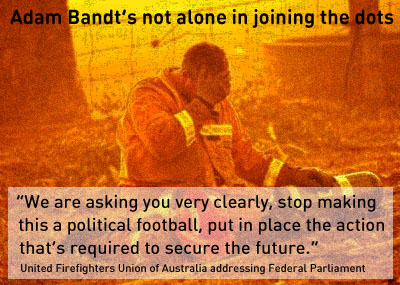
Bushfires are raging across the state of New South Wales in Australia. It's only Spring. Something is up. Yesterday, the Greens Member of Parliament, Adam Bandt, made headlines by suggesting that climate change is connected with the deadly NSW bushfires, which are causing widespread destruction. It has been treated as if he was speaking like a radical - by the media and by deniers. But there is nothing radical about what Bandt said - it’s what the Bureau of Meteorology have said and it’s what the Firefighters Union have said when addressing Parliamentarians:
"We are asking you very clearly, stop making this a political football, put in place the action that's required to secure the future because by 2020 we are going to see a frequency like we've not seen before." -- United Firefighters Union of Australia
It’s deeply worrying that, here in Australia, the causes and impacts of climate change have remained a political football. The increasing frequency and severity of bushfires show us that we can't hide from climate change impacts - they are happening already - not just here but all over the world. From the melting of the Arctic, larger cyclones hitting the Philippines, wildfires and drought in the United States, the list goes on. We’re entering a new era of weather extremes and it has a deadly toll.
How can any of us watch, be affected and not be frightened about what climate change means for all of us in Australia? We can't bury our heads in the sand -- we need to face what we're up against and insist on political action to reduce our emissions and avoid further community devastation. Bushfires aren't political, but we need political action to stop them.
What can we do?
1. Talk about it! It's a real concern and we need to talk to our politicians (pick up the phone and call your MPs and Senators), your local paper or radio station, your community and neighbours. Don't let deniers stop you voicing your concerns about the climate impacts we face nor the action needed to address them!
Suggested Tweets:
- Wildfires in October? Let's connect the dots: #climate change is driving extreme weather and wildfires. @TonyAbbottMHR @SMH @abcnews
- @SMH @abcnews We need to be talking about the link between climate change, wildfires and action to reduce emissions
- I stand with @AdamBandt and Firefighters: Message to @TonyAbbottMHR stop making #climate change a political football, make it about action.
- My sympathy goes out to all impacted by NSW bushfires. Let’s take action on #climate change seriously so fires don’t get even more wild.
Share this image on Facebook by clicking here or on the image.
2. Divest! If we are to avoid further extreme weather impacts, it’s time to take away the power of the industry that’s driving these impacts. By moving our money out of fossil fuels, we can start to erode the industry’s social license and motivate the political action our climate so desperately needs. Find out how you can start moving your money today!
It’s time to show that this isn’t just about something a Greens Parliamentarian feels strongly about, but it is an issue and a real challenge that we all face. If last summer was anything to go by, the coming summer won't be pretty - it’s time to talk and it’s time to act.
Our heartfelt sympathies go out to all those impacted by the bushfires. In writing this, we are not seeking to make your suffering a political opportunity, rather a chance to call for action so that further suffering may be avoided.
First Nation Fracking Protest Escalates in New Brunswick

Our allies in Canada have urged us to spread the word about an important fossil fuel resistance effort underway in the town of Rexton, in New Brunswick, happening now. New Brunswick is one of the largest geographic areas under consideration for expanded fracking. For more information about Shale Gas drilling in New Brunswick, click here.
A group First Nations protestors and their allies gathered in the region to confront expanded shale-gas drilling, beginning on Sept 30, according to the Canadian Broadcasting Company.
Please help spread the word about this as a way to support our allies. Here is a livestream to follow updates.
Global Frackdown

We are nearly a week into Reclaim Power — a global month of action on energy. The next big day to come up is this year's Global Frackdown, a day when communities around the world are uniting to demand a shift to clean, renewable energy and debunk the myth of shale gas as bridge fuel.
Click here to find events planned near you.
To help get the word out in the coming days, there is a whole set of social media resources to help make it easy to spread the word online here: https://www.globalfrackdown.org/social-media
And here's a clip of 350.org co-founder Bill McKibben joining in the call to action for this Saturday:
Cyclone Phailin and Climate Change, Connecting the Dots
Crossposted with some edits from Huffington post
Over the past two days, I was glued to my television screen as one reporter after another stood in the rain and braved gusty winds to give the world a very detailed account of the cyclone Phailin that hit the eastern sea coast of India. Such reportage was unparalleled especially in comparison to the reporting around the massive super cyclone that hit the same region in 1999. 24 hour broadcasting ensured the cyclone's landfall made it to TV screens at the same instant as it ravaged through villages and towns in India.
Even with all the technology and the TRP buzz, one vital issue has remained out of discussion so far and that is the elephant in the room, Global Warming. I've been chided several times by reputed individuals in the field of science to not connect any single weather event to climate change and rightly so, it's simply not scientific to beat the climate change drum for my campaigning cause. But when these very scientists, whole 800 of them, unequivocally state that extreme weather events are on the rise and countries like India are highly vulnerable, I find it counter productive to not connect the dots from cyclone Phailin to climate change.
Let's take a brief look at the science. Cyclones are low pressure systems that form over warm tropical oceans. They derive energy from the warmer waters and do not form unless the temperatures are over 26.5 degrees C. The recorded temperature in the Bay of Bengal where Phailin developed was 28-29 degrees C with very high heat content. The sea surface temperature variations over the past few decades show an increasing trend, more particularly pronounced since 1992. Twenty-six of the thirty-five deadliest tropical cyclones in world history have been Bay of Bengal storms. During the past two centuries, 42% of Earth's tropical cyclone-associated deaths have occurred in Bangladesh, and 27% have occurred in India.
The Overseas Development Institute (ODI), an influential think tank stated in its new report titled "Geography of poverty, disasters and climate extremes in 2030" that India ranks highest in its risk to extreme weather disasters. "Over the two decades many parts of India - including Andhra Pradesh - will be increasingly exposed to disasters. The focus on how deadly disasters can be should not obscure the fact that many homes, hospitals, shops and schools will have been badly impacted in ways which will drive people into poverty", said Dr. Tom Mitchell from ODI. Climate change is as much about politics as it is about science and to act on it would require political mobilisation preceded by a greater public demand to acknowledge and act on this clear and present danger.
India's response to Phailin has been commendable. Over 800,000 people have been evacuated and the casualty rate has been remarkably low. With rapid deployment of the army, navy, coast guard and other reserve forces along with makeshift relief centres, thousands of lives have been saved. Disaster preparedness is as much about livelihoods as it is about lives and the cyclone's impact has been devastating with 9 million people affected and huge losses to crops and homes. Their rehabilitation and restoring their livelihoods is a daunting task. Phailin should therefore be another stark reminder for us think hard about climate adaptation in what is now a new normal in our planet's weather.
The Uttarakhand floods in June, Maharashtra’s drought, floods in Assam and now Phailin give a quick glimpse into the havoc climate change can play as many other disasters are awaiting India tomorrow. Ignorance and denial are not an option anymore and further inaction will come at our own peril.
350 India is organizing an online #ClimateChat on Friday, October 18th 2013 at 5 PM IST. Anyone with queries about climate change, its impacts, causes, perceptions and solutions in the Indian context can pose their questions to a reputable panel via twitter using the hashtag #climatechat. The chat will take place on Google Hangout and those interested can register here.

Let the truth prevail: Confronting the Power Finance Corporation Limited, India
I usually find news paper advertisements boring, but a small invite to pre-bid conference for proposed 4000 MW Ultra Mega Power Plant (UMPP) caught my attention. Ignoring a restraining order by the National Green Tribunal India, the project promoter Power Finance Corporation Limited, India has announced bid process for UMPP proposed in Cheyyur District of Indian State of Tamil Nadu. In past PFC has lied to the people and authorities of Cheyyur about upcoming project and now they were trying to hide facts from investors as well. Someone had to put an end to all lying. So we at 350 India, decided to confront the concerned authorities and warn the investors as well. With help from our friends at Community Environment Monitoring, a list of fraudulent statements and misrepresentations used by Coastal Tamil Nadu Power Ltd to facilitate environmental clearances for 4000 MW Cheyyur UMPP was prepared. The plan was to hand out these letters to the potential investors warning them of risks associated with this project.

It was bit difficult to blend in the suit clad crowd and pretend to be as one of interested developer. However the short film on the project site followed by a presentation boosting about state of the art technologies being adopted to protect environment, made us laugh and even more determined to expose the lies in the Environment Impact Assessment report submitted by the PFC officials. During the open discussion, one by one we started asking hard hitting questions about court orders & land acquisition. While the authorities tried to duck these questions few more investors expressed their concerns over the way the clearance was sought. Suddenly from technical discussion the focus shifted to environment and forest concerns. However the key moment was when we directly mentioned about the fraudulent claims and walked to deliver the letter to the panel. All eyes were glued to us as we were distributing the letter in middle of the meeting. We were hoping we would be asked to leave immediately, but the organizers were too shocked to react and we got stay till the end of the meeting.

As we prepared to leave the conference we were surrounded by anxious investors asking for a copy of the letter. Soon we ran out of copies of letter. We never expected our small action would be taken so seriously by investors present. No wonder we were not invited for post conference lunch for the organizers.

The small action was in solidarity with people of Cheyyur, fighting to save their land and water resouces. Visit https://cheyyur.
12 Photos of Divestment Campaigns Unleashing in Australia and New Zealand
Since launching broad divestment campaigns in both New Zealand and Australia during Bill McKibben's June tour, the campaigns have now focused in and targets are lined up. Today marked a new phase of campaigning in both countries, and builds on the rapid successes of various religious institutions paving the divestment way. Here are 12 photos from things that happened today across both countries (more are rolling in!). All these efforts coincide with the international Reclaim Power Month of Action.

In New Zealand, 350 Aotearoa and Coal Action Network Aotearoa launched a campaign calling on Westpac bank to stop financing Bathurst Resources Ltd, the company which has plans to dig up coal on the Denniston Plateau - an important conservation area home to rare species of geckos, prostrate plants, giant snails and kiwi. Westpac makes big promises around its sustainability practices and its time it lived up to them by not funding climate change. You can send them a letter asking them to withdraw their financial support to Bathurst Resources here. The 350 Aotearoa team also kicked off the first of their Divestment Forums tonight - to a great crowd in Auckland.
Meanwhile, across the ocean and not too far away, students from across 18 of Australia's universities joined together for a Fossil Free Universities day of action. In-roads are already being made at campuses like the Australian National University and Monash University. Over the coming months and into next year we'll be expecting to hear much more as all these Fossil Free Campus groups ramp up their campaigns that are pushing their universities to divest. Meanwhile, later this week we'll see 500 people turn out to Divestment Forums in Brisbane and Melbourne, as part of a series of forums around the country. Check out some of the fantastic photos that came from the day of action (a slideshow of them is viewable by clicking here):

University of Queensland

Melbourne University

University of Tasmania

Monash University