Fighting Australian coal from India
Organisers in Hyderabad, India protested outside the annual general body meeting (AGM) of the infrastrucutre company, GVK on August 12th. GVK is making a terrible investment choice and planning the 10 billion USD Alpha coal project. The project constitutes a coal mine in the Galilee basin of central Queensland that if burnt will eat away 6% of the global carbon budget, a port to export coal to India and other North Asian countries that falls within the Great barrier reef heritage area and railway lines that cut through some of the most beautiful farms and landscapes in Australia.
Even economically, the project has been thrashed as highly dubious and investors were warned not to make such a risky financing. Activists in Hyderabad gathered to protest outside the company AGM with messages from Indians and Australians alike to stop this dangerous project. The protest was quelled by the local police and the organisers detained for a couple of hours. Below is a slideshow of images with messages from friends in Australia who are ready to fight GVK, images from the action in Hyderabad and the action video.
Please share the story and these images with your networks as we hope to escalate pressure to stop the project.
Joyful, unyielding.
We just sent out this email to our friends in the USA. Not on our email list yet? Sign up here to receive crucial updates from the climate movement.
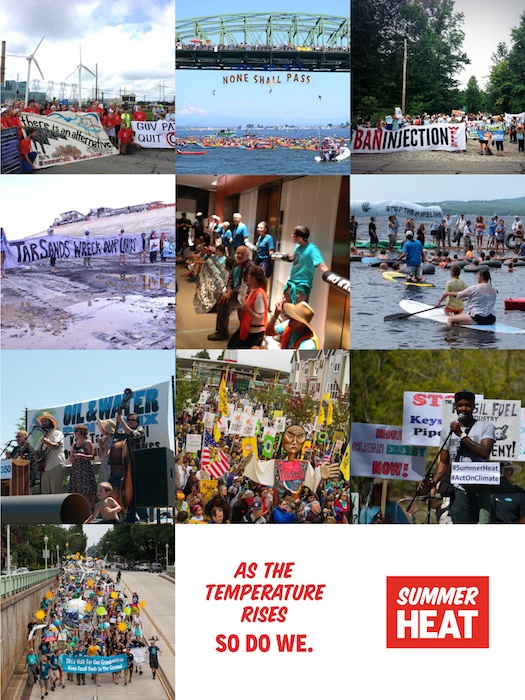
My wife Sue and I criss-crossed America these past few weeks -- from the Mackinac Straits of Michigan where they want to run tar sands oil through aging pipes beneath the Great Lakes, to the Chevron refinery in Richmond, California where they'd like to turn tar sands into gasoline. We saw coal plants, fracking wells and stretches of Pacific coast they'd like to turn into carbon ports.
But mostly we saw people -- the beautiful face of a movement that's growing, learning, coming together.
It's incredibly diverse, as one would expect -- people in Maine are from people in Moab, Utah are different from people in Trumbull County, Ohio. But no matter our differences, everywhere we share an adversary: a fossil fuel industry so focused on greed that they're willing to rip apart the planet and its communities.
We've put up a slideshow with photos and reportbacks from Summer Heat events -- it's a small glimpse of the power and beauty shown across the country in the past few weeks. Click here to see it: 350.org/en/about/blogs/what-happens-when-climate-movement-decides-summer-isnt-hot-enough
Everywhere I went, people also shared a spirit: firm, joyful, unyielding. I particularly liked the banner that hung from the I-5 bridge over the Columbia River: "Coal, Oil, Gas: None Shall Pass." It all has to stay under ground.
For a few weeks we took the hottest stretch of the summer and turned it politically hot as well. A lot of people felt the pinch of handcuffs -- myself included -- but they felt the embrace of the rest of the movement too. Everywhere people were embracing the power of the local climate justice movement, in all its forms.
If this was a movement of a few big organizations or a few leaders, then the industry wouldn't need to worry so much. But instead there are thousands of local leaders, and hundreds of local organizations -- and they're linked together in new, exciting ways that spell trouble for the fossil fuel barons, and hope for a troubled earth.
So many thanks to everyone who raised the heat. Let's keep going,
Bill McKibben
This is what happens when the climate movement decides summer isn’t hot enough.
Featuring...
Richmond Summer Heat – Bay Area
President Obama — Keep your Promises – DC
Flotilla to keep New England tar sands free – Maine
2013 Walk for our Grandchildren – Maryland
Shut Down Brayton Point – Massachusetts
Oil and Water Don’t Mix: A Rally for the Great Lakes – Michigan
Rally at the Rio! – New Mexico
Don't Frack Ohio 2.o – Ohio
Pacific Northwest stands up to fossil fuel exports – Portland, OR
Utah Tar Sands Action Camp – Utah
Sample Page
This is an example page. It’s different from a blog post because it will stay in one place and will...
350 Vietnam presents in Saigon
This post is written by Katharina Mengede, one of our 350 Vietnam volunteers.
On Tuesday 350 Vietnam had the great pleasure to present our work and our recent efforts at an event called Green Drinks. Green Drinks is a monthly, informal session, which provides individuals, young NGOs and established organizations in the green field the occasion to share their visions and ideas.

Why 847 is an important number for India
In India, climate change is not a mainstream issue. For a vibrant democracy of 1.2 billion people, a sound scientific community and a hyper active media, one would imagine an issue that threatens the lives of a majority of Indians would be discussed, but it isn't! And we are asking public personalities in India to help change this and elevate global warming to the national discourse. Sign this petition and urge them to speak out!
In June, the northern state of Uttarakhand experienced one of its worst floods in recent history. A state that nestles within it, piligrimage sites that attract millions of people from around the globe. The image below is poignant and scary in which we see the idol of Lord Shiva (the bringer of destruction) drowning in the flood waters.

Unrestricted contruction of buildings on river basins, unchecked tourism, reckless growth of dams and poor policy lead to devastating impacts on human and animal life and the economic costs of dealing with the floods is billed at $ 1.2 billion. Whilst the above reasons made the floods worse, the fact remains that the state received 847% excess rainfall between 13-19th June 2013. The melting Himalayas added to the intensity of the floods which is now dubbed as a "Himalayan Tsunami".
We are asking everyone to sign this petition and urge public personalities in India to raise the profile of the issue. As simple as a tweet from some of them (who have millions of online followers) can spark off a much needed discussion on global warming in India. Help create the new discource on climate change in India!

This West Sussex community has spoken: thou shalt not frack
I often ask myself: how much longer can the rogue forces of the fossil fuel industry continue wrecking our planet with impunity? Today I was reminded of our movement’s recurring answer to that question: not for long, if we can help it.
In the early hours of the morning, anti-fracking activists and community members in Balcombe, Sussex, UK, successfully halted the first day of explorations for a new shale oil development by famed (infamous, rather) fracking company Cuadrilla. Over 250 people united in a powerful, peaceful, joyful blockade -- that eventually convinced the trucks containing the initial fracking equipment to abandon the site.

Photo credit: Frack Off
This is community power at its best. Campaigners in Balcombe, just like those in frontline communities around the world (in the US, Indonesia, Argentina, and elsewhere) had been calling attention to the dangers of fracking for over a year. This week, when Cuadrilla’s license for exploration and development was approved, activists quickly mobilized to organize a Great Gas Gala, inviting people in Sussex and neighboring areas to converge on Balcombe and oppose Cuadrilla’s efforts.
Today’s protests are set in the context of a recent announcement by the UK government proposing a 50% tax cut for companies involved in shale gas extraction, the most generous tax regime for fracking in the whole world. The proposal is very much in line with the dreaded “dash for gas” that the Chancellor, George Osborne, announced at last year’s unveiling of the budget.
It is in opposition to these efforts that groups like Frack Off, No Dash for Gas, and many of our partners and allies around the country, are mobilizing public awareness and opposition, in a genuine effort to shift the power in our energy systems and put our communities and their people back in charge. The Global Power Shift UK team will be working in the upcoming months on helping build that large, inclusive movement -- one that represents community interests, leverages our diversity, and builds on our shared vision of a people-powered future that solves the climate crisis once and for all.
The fight in Balcombe is not over yet. Today’s exploratory fracking attempt (make sure to check out the amazing pictures) was the closest to London to date, where a lot of the finance for these operations comes from and where the tangled webs of power and influence are carefully threaded between consenting politicians and short-term profit oriented fossil fuel corporate executives. Impunity for them and their climate-wrecking efforts? No longer. Real resistance is brewing in their backyard.
###
UPDATE: The situation is in continuous development. For latest news, follow Frack Off and the Great Gas Gala websites.
CORRECTION: The post initially referred to shale gas -- the Balcombe fracking site is believed to contain shale oil instead.
Europe’s largest lenders take small steps away from fossil fuels
...but while these steps might be in line with policy, they’re far from the realities of science and justice.

Photo: The EBRD is based near Liverpool St, London. Not surprisingly, London is also home to one of the world’s biggest stock exchanges, most heavily invested in fossil fuels.
There has been a lot of talk over the last few weeks of big public financial institutions altering their lending policies, looking to phase out support for fossil fuels. These mainly positive developments have been cautiously welcomed by climate campaigners. Although they show increasing alignment with EU policy designed to mitigate climate change, they are far from what science and justice demand.
Recently, the World Bank amended its lending policies for new coal-fired power projects, restricting financial support to countries that have "no feasible alternatives" to coal. Arguing that funding coal-fired power plants is sometimes necessary to bring energy to the world's poorest nations and help eradicate poverty, they fail to explain why this goal couldn’t be equally achieved with clean, renewable energy infrastructure.
This week, the European Investment Bank (EIB), the world's largest public financial institution, announced that it would be applying an Emissions Performance Standard (EPS), to all new fossil fuel projects. While this is an encouraging step in the right direction and it’s likely that an EPS of 550g CO2 per kWh will initially rule out the dirtiest forms of coal, a target of 350g CO2 per kWh, is what’s needed to show serious intent to rise to the challenge of climate change.
The EIB announcement also introduces exemptions that will leave the door open to business as usual, more coal and other extreme fossil fuel projects such as fracking – none of which are compatible with a world under 2 degrees of warming. The EIB draft policy states that when “a [coal] plant contributes to the security of supply” within the EU or when “it contributes to poverty alleviation and economic development” outside of the EU, it might well be eligible for funding.
Energy poverty is often cited as justification for building new coal plants in poor countries, however the extent to which they have an impact on energy access and security of supply is questionable. It is in countries where rural communities make up a significant proportion of the population that impacts, such as respiratory illness and loss of land and livelihoods, of fossil fuel energy projects are primarily felt. Large scale, centralised, dirty power from coal tends to benefit industry before people. Whereas decentralised, community owned renewable energy seem to make much more sense in both terms of access and security of supply.
We know that to avoid the extreme worsening of the climate crisis we have to leave 80% of the fossil fuels we already have access to in the ground. Recently, Connie Hedeggard, EU commissioner for Climate Action, called on the EIB, World Bank and European Bank for Reconstruction and Development (EBRD) to divest from fossil fuel projects. Combined, these institutions are responsible for $130 billion of lending, of which $37 billion has been given to coal projects over the last five years.
With the recent announcements from both the World Bank and the EIB, it’s perhaps now time to turn attention to the European Bank of Reconstruction and Development (EBRD) as it hears comments from various stakeholders on its new draft energy strategy in London today. While a draft proposal shows criteria for lending tightened, campaigners warn there is still room for the Bank to continue lending to the “very dirty coal projects” and are calling on the EBRD to “follow the World Bank and EIB’s example, and to clean up their act too.”
Over the coming months, as the divestment campaign catches on across Europe, we’ll be looking to work closely together with our friends and allies across Europe, including Bankwatch, Counterbalance, Re:Common, Urgewald and many more to help put an end to use of public money for the development of fossil fuel projects.
Join our mailing list and keep up to date with our work and opportunities to get involved as they develop.
This is actually the Prime Minister of New Zealand
I'm from New Zealand, and I need your help.
Whenever I meet people overseas, there's usually a perception that New Zealand is one of the only places left on Earth that is clean and green. It's partly true - it's a very beautiful place. If you go hiking, or 'tramping' as we prefer to call it, you can walk for a week and not see anyone if you pick your hills right. The stunning snow covered mountains do look a bit like in the Lord of the Rings and the Hobbit - mainly because that's where it was actually filmed.
But it's time to set the record straight, because there's also the perception that the New Zealand Government is a relative saint when it comes to taking care of the environment and taking action on climate change. Rather than explain to you at length in words how this perception is dangerously wrong, all you have to do is watch this video clip of the actual New Zealand Prime Minister, John Key (and no, it's not a Flight of the Conchords parody, although I desperately wish that it was). He lays out his plans to dig up as much of New Zealand for resources as he can, and to drill deeper and deeper oil wells in our oceans - even when powerful earthquakes, like the 6.5 quake that hit Wellington this week are striking at these drill sites.
All of this comes at a time when we know that the world has already gone too far in sucking out every last bit of fossil fuels we can find, and there comes a time to say No More. So in the coming months and year, our team in New Zealand will be scaling up our efforts to show our outrage at John Key and his Government, and that we shall not stand idley by as they plunder New Zealand. The number of jobs and royalties Key quotes are hardly to be the 'game changer' he suggests them to be. It's classic 20th century politician policy - so desperately uncreative and unoriginal it's appealing to some people. There are so many other ways New Zealand can prosper and grow, without short-term greed and plunder. Yes it won't always be easy, and it will take creativity, entrepreunership and hardwork, but those qualities are at the core of the good old Kiwi, No.8 wire spirit, so I don't doubt for a minute that we could do it.
So will you help us as we gear up to hold back the plunder of New Zealand - and share this so we can set the record straight with the rest of the world (you can tweet at him: @johnkeypm). The fight is on to keep New Zealand the way it should be.
A Magazine of Our Movement
I woke up this morning to find a local volunteer in Melbourne, Australia had sent me a magazine. No - not a magazine about the royal couple's new baby. All congratulations to that royal couple, but really, this magazine is far more interesting: the Global Fossil Fuel Divestment Movement magazine!
It was less than two months ago that we officially launched divestment campaigning in Australia, during Bill McKibben's Do the Maths tour. Since then it's been a scramble for us to keep up with the explosion of divestment campaigning across the country, from university campuses to churches, to towns and cities. At the sametime, we've been learning and sharing resources with divestment campaigners in the United States - who have even got Obama uttering the word "divest". Now we're looking to Europe as divestment looks set to take hold there in the coming months.

Graham Clark has been watching and documenting the movement closely and has pulled together many of it's successes, highlights and stories into this epic 30 page online flip magazine. It's truly inspiring to see how much this movement has achieved in a very short amount of time, and the momentum brewing for the coming months and years. So take a look, share and enjoy!