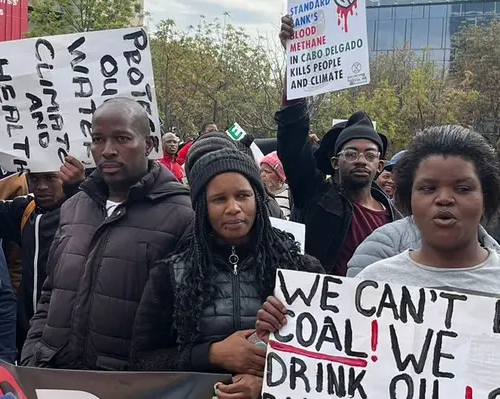
STANDARD BANK’S GREEN CLAIMS CHALLENGED IN FORMAL ADVERTISING REGULATORY BOARD COMPLAINT
Civil society complaint asks advertising regulator to scrutinise whether Standard Bank can market itself as a leader in sustainable finance and climate action while financing the East African Crude Oil Pipeline
Johannesburg, 28 October 2026
A formal complaint filed yesterday with South Africa’s Advertising Regulatory Board (ARB) challenges Standard Bank over misleading environmental and climate claims which contrast with its continued financing of major new fossil fuel projects.
The complaint was lodged by Fossil Free South Africa (FFSA), represented by Lawyers for Human Rights. They are joined by StopEACOP Coalition, an international coalition of frontline community organisations and civil society groups.
At the heart of the complaint is Standard Bank’s involvement in financing the East African Crude
Oil Pipeline (EACOP), while simultaneously presenting itself as a leader in sustainable finance,
climate mitigation and Africa’s just energy transition.
The complaint asks the ARB to scrutinise environmental claims contained in Standard Bank’s 2025 Report to Society and its Climate-Related Financial Disclosures, as well as claims made through its commercial Energy Finance, Infrastructure Finance and Sustainable Finance advertising.
According to the filling, these promotional materials portray Standard Bank as a “leading provider of sustainable finance solutions” and a “leading enabler of Africa’s just energy transition”, while promoting commitments to renewable energy, reductions in fossil-fuel exposure, water conservation, biodiversity protection and net-zero financed emissions by 2050.
The complainants argue that these claims cannot be assessed in isolation from what the bank actually finances.
Standard Bank is among the financial institutions backing EACOP, a 1,443-kilometre heated crude-oil pipeline stretching from Uganda’s oilfields to the Tanzanian coast. The project cuts through communities, wetlands, river systems and ecologically sensitive areas and has become one of the most contested fossil-fuel infrastructure developments on the African continent.
To substantiate the greenwashing charge, the complaint highlights the severe footprint of the Project. Peak production is projected to generate up to 34 million tonnes of carbon dioxide equivalent annually at peak production and approximately 379 million tonnes over the project’s lifecycle. Furthermore, the pipeline’s path breaches 158 wetlands in Uganda, eleven rivers and dozens of legally protected, ecologically sensitive areas.
At the same time, communities affected by EACOP have reported land loss, economic displacement, disputes over compensation and threats to livelihoods, while environmental and human rights defenders opposing the project have repeatedly faced harassment, arrests and intimidation.
More than 40 banks and 30 insurers internationally have distanced themselves from EACOP or adopted policies excluding the project or projects of its kind. Major South African financial institutions including Absa, FirstRand, Nedbank and Investec have also declined involvement.
Against this backdrop, the complaint asks whether Standard Bank’s extensive use of the language and imagery of sustainability accurately reflects the environmental consequences and limitations of its financing activities.
“We are asking the Advertising Regulatory Board to test whether the environmental image Standard Bank sells to the public can actually survive scrutiny against the reality of the projects it finances.” said Kholwani Simelane, Campaign Coordinator and Team Lead at Fossil Free South Africa.
“Standard Bank wants the South African public to associate its brand with wind turbines, renewable energy, sustainable finance and a just transition. Yet, they are helping finance a massive new crude-oil pipeline through East Africa.”
The complaint raises a series of concerns about Standard Bank’s claims of sustainability leadership, renewable-energy finance, fossil-fuel reduction, net-zero alignment, water stewardship and environmental responsibility.
Among the contradictions highlighted is Standard Bank’s commitment to achieving net-zero financed emissions by 2050 while supporting infrastructure expected to facilitate crude-oil production and transportation for decades. The complaint also challenges the bank’s assertion that EACOP satisfies the Equator Principles and IFC Performance Standards and asks Standard Bank to substantiate that claim. It further questions how commitments to water conservation and environmental stewardship can be reconciled with financing a pipeline that passes through or near extensive freshwater systems, including the Lake Victoria basin, upon which tens of millions of people depend.
“For people living along the EACOP corridor, this is not an abstract debate about corporate language,” said Zaki Mamdoo, the Coordinator of the StopEACOP Coalition.
“Communities have lived with the consequences of this project through the loss of land and livelihoods, pressure on local ecosystems and the repression of those who have challenged it. Financial institutions should not be able to present themselves elsewhere as champions of climate action and environmental stewardship without being accountable for what their money is making possible.”
Under the ARB Code, environmental claims must be substantiated and must not mislead consumers through omission, ambiguity, inaccuracy or exaggeration. The complaint asks the ARB to scrutinise Standard Bank’s environmental advertising, require evidence for claims relating to climate alignment, fossil-fuel reduction and sustainable finance, and direct the bank to amend, qualify or withdraw any representations found to be misleading or insufficiently substantiated. In this sense, the case goes beyond one advertisement or one pipeline and raises a broader question about whether financial institutions can continue to market themselves through the language of sustainability while financing the expansion of fossil-fuel infrastructure.
“Greenwashing matters because advertising shapes how the public understands where money is flowing and what kind of development financial institutions are building,” said Brighton Aryampa, a Ugandan Human and Environmental Rights Lawyer working with EACOP-impacted communities.
“This is not an argument that financing one fossil-fuel project automatically erases every renewable-energy investment Standard Bank makes. The question is whether the overall story being presented to the public is an honest one.”
For communities resisting EACOP, the complaint marks another front in a years-long struggle to hold the financial institutions enabling the project accountable.
The future Standard Bank advertisements must now be measured against the future it is financing.
ENDS
Notes to editors
The complaint was filed with the Advertising Regulatory Board of South Africa on 27 October 2026 by Fossil Free South Africa (represented by Lawyers for Human Rights) and on behalf of the StopEACOP Coalition - a broad coalition of frontline community organisations and local and international civil society organisations.
The complaint concerns environmental representations contained in Standard Bank’s Report to Society 2025, its 2025 climate-related financial disclosures and commercial advertising for its Energy Finance, Infrastructure Finance and Sustainable Finance services.
The complaint does not ask the ARB to determine whether all fossil-fuel financing is incompatible with sustainable finance. It asks the regulator to determine whether Standard Bank’s specific environmental representations are accurate, appropriately qualified and capable of substantiation in light of its documented financing activities, including its involvement in EACOP.
EACOP is a 1,443-kilometre heated crude-oil pipeline running from Uganda to the Tanzanian coast.
The complainants seek, among other relief, an assessment of the challenged representations under the ARB Code of Advertising Practice and the amendment, qualification or withdrawal of any advertising found to be misleading, insufficiently substantiated or inadequately qualified.
For interviews and further information:
Abiud Onyach
StopEACOP Coalition Communications & Digital Lead
[email protected] | [email protected]
+254 727 670 279
Zaki Mamdoo
StopEACOP Senior Campaign Coordinator
[email protected] | +27 81 395 9738
Copies of the ARB complaint and supporting documentation are available to the media on request.
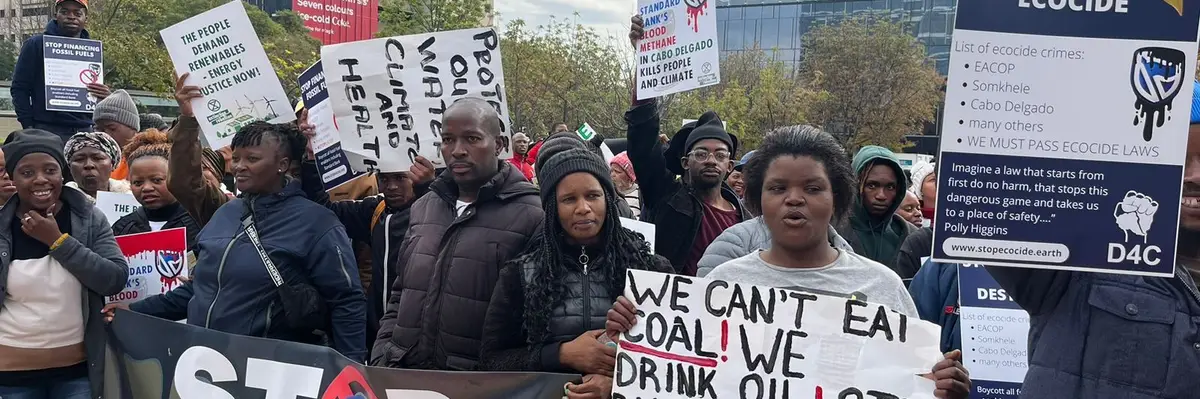
Related press releases
Big Oil's $53 billion profit bonanza comes as El Niño threatens millions of lives
350.org challenges West Virginia Attorney General’s subpoenas