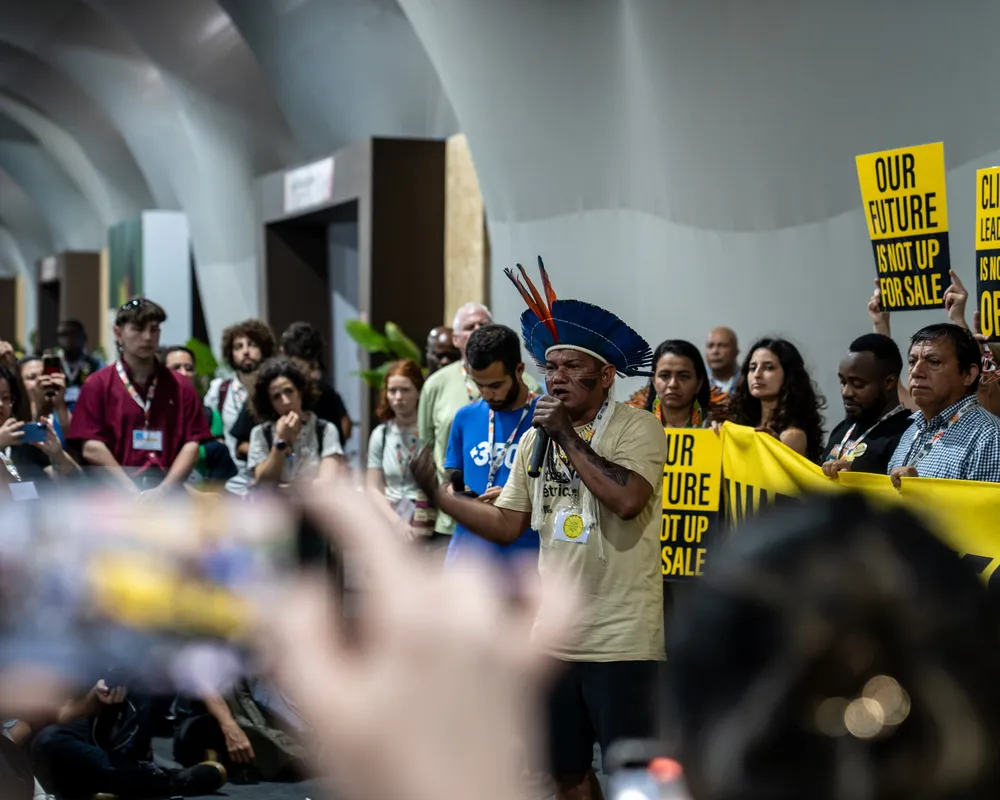
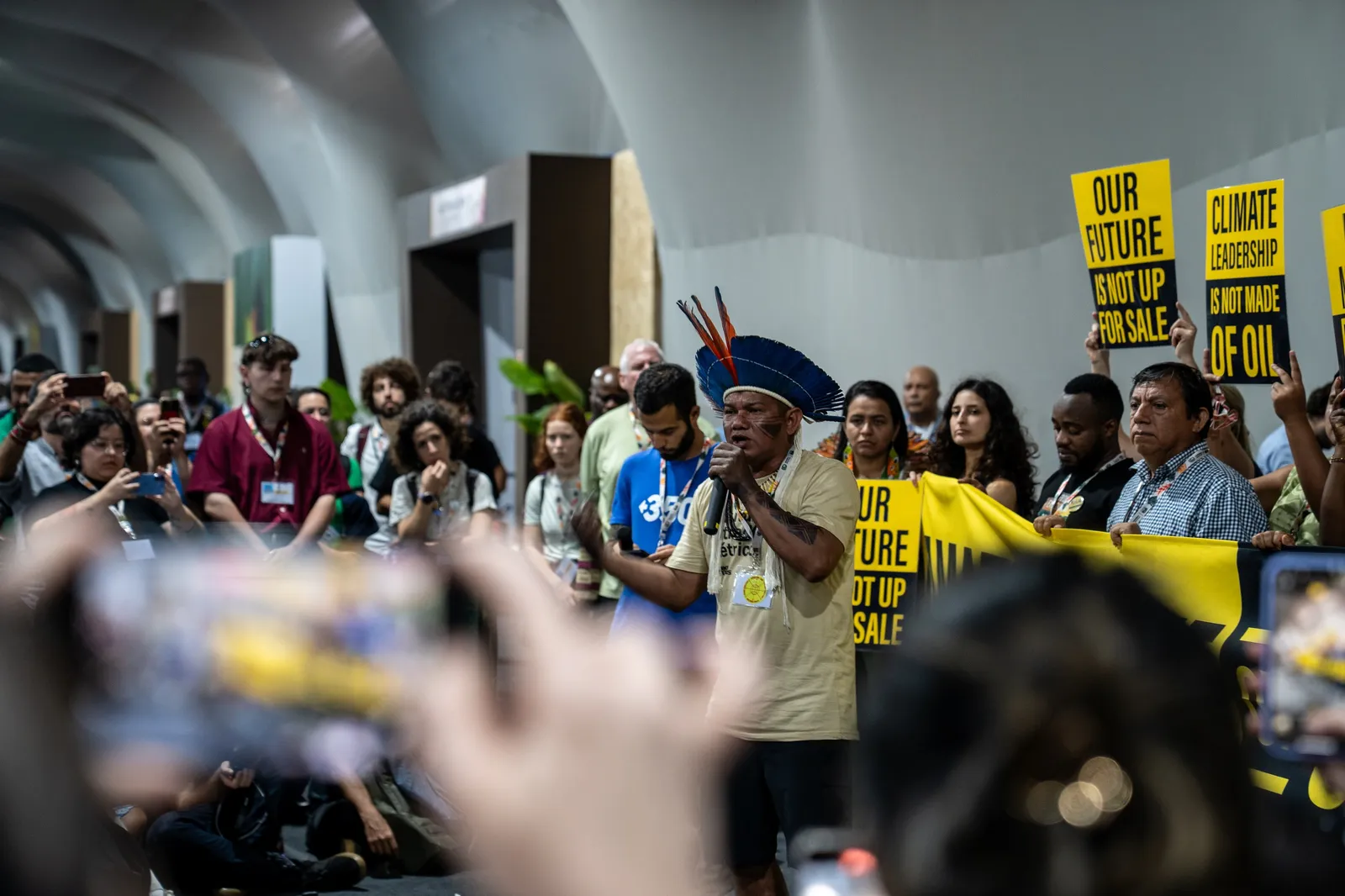
Photos and videos of the action here
Belém, Brazil – As world leaders gather in the heart of the Amazon for COP30, civil society groups and Indigenous leaders staged a peaceful protest inside the UN Climate Summit to denounce the ongoing expansion of oil and gas projects, a move that directly undermines global climate goals and the promise of a just energy transition.
Holding banners reading “Amazon Free of Oil and Gas”, “Climate Leadership Is Not Made of Oil”, and “Our Future Is Not Up for Sale,” participants from across Brazil, the Global South, and international organizations and networks demanded real progress at COP30 toward phasing out fossil fuels and defining how a just and equitable energy transition will take place.
The protest highlighted the stark contradictions between climate pledges and actions. In Brazil, the government recently approved new oil exploration near the mouth of the Amazon River, not too far away from where negotiations are taking place. Meanwhile, countries in the Global North, including the United States, Canada, Norway, and Australia, continue to expand oil and gas production, despite their historical responsibility for the climate crisis.
Activists emphasized that the “COP of Truth,” as President Lula called it, will only live up to its name if his words are matched by courage and action — delivering concrete commitments and timelines to end fossil fuel expansion, protect the Amazon, and build a truly just energy transition led by Indigenous and traditional communities.
Civil society groups emphasized that COP30 must be a turning point for climate ambition, delivering concrete commitments to phase out fossil fuels equitably and rapidly, in line with the 1.5°C goal. The final agreement should include strong language on ending fossil fuel dependence, setting clear targets to triple renewable energy with fair, public financing. They also called for Indigenous peoples, frontline communities, and workers to be at the center of negotiations and decision-making, ensuring that the transition is truly just, inclusive, and free from the influence of polluters.
Background
- In October 2025, the Brazilian government authorized new oil drilling near the mouth of the Amazon River, ignoring the requirement for free, prior, and informed consent and provoking strong backlash from Indigenous and traditional communities across the region, who know that such projects put their ways of life and local ecosystems at risk.
- Countries of the Global North remain among the largest producers and exporters of fossil fuels, while delaying commitments to phase-out despite their disproportionate emissions and wealth.
- As the host of COP30, Brazil faces growing pressure to lead by example and ensure that the summit delivers real progress toward ending fossil fuel expansion and financing a just energy transition for all.
Comments from participants:
Chief Ninawa Huni Kuin, FEPHAC and Inu Institute coordinator:
“At COP30, in our home, the Amazon, Brazil must choose: will it lead the world toward the end of fossil fuels, or continue digging, drilling, and burning our future?We, the indigenous peoples, are the guardians of life. Our forests, our rivers, our seas, our lands, these are not resources for sale, they are life itself. We need our territories demarcated, our rights respected, our voices at the table. Because as long as oil continues to flow, justice will not flow. As long as the planet burns, there will be no solution—only more loss, more silence, more pollution.”
Chief Jonas Mura, APIRA and GTA Network coordinator, said: “At COP30, the peoples of the Amazon are inside the Blue Zone to remind everyone that there can be no energy transition while oil and gas continue to advance on our lands. While governments negotiate targets and licenses, we continue to fight for our lives. For us to have a COP of truth, the transition must begin with our voice, the Amazon must stop being treated as a sacrifice zone and become the center of climate justice.”
Bianca Barbosa, quilombola leader from Marajó and project manager at the Marajó Observatory:
“In Marajó, our struggle is also for a just energy transition, and we don’t want oil exploration at the Amazon River mouth to be seen as something that will bring development to our territory. What we, as Marajó youth, want is investment in education so that our young people can also take part in this energy transition — and have the autonomy to create and maintain new technologies.”
Mariam Kemple Hardy, Global Campaigns Director at Oil Change International, said: “The transition is people-powered and already underway in many parts of the world, but a handful of rich countries are derailing global progress. Since signing the Paris Agreement, the U.S., Canada, Australia, and Norway collectively have massively increased their oil and gas by nearly 40% instead of phasing it out – and are also driving the majority of the world’s planned oil and gas expansion through to 2035.
“A fair future means these rich countries must phase out first, fund the energy transition in the Global South on fair terms, and stop putting profit over people and planet. The COP Presidency must use this year’s UN climate talks to move countries from commitment to implementation. That means delivering binding timelines for a fast and fair fossil fuel phaseout through real political leadership, just transition policies that support workers and communities, and debt-free financial support for the Global South.”
Aryampa Brighton, Ugandan practicing lawyer and team leader at Youth for Green Communities: “ From Uganda to the Amazon, our message is the same. There can be no just transition built on the suffering of frontline communities and criminalization of the anti-fossil fuel activists. The continued expansion of oil and gas is not development, it is destruction disguised as progress. COP30 must be the moment leaders stop speaking of ambition while licensing new wells. True climate leadership means standing with the people whose lands, rivers, survival, identity, and rights are sacrificed for profit, and having the courage to finally say no to fossil fuels”
Media Contacts:
Rachel Brabbins (On site in Belém, GMT-3)
Email: [email protected]
Phone (WhatsApp & Signal): +55 21 98299 8251
Mariana Abdalla (On site in Belém GMT-3)
Email: [email protected]
Phone (WhatsApp & Signal): +55 21 99823 5563
Valentina Stackl (On site in Belém GMT-3)
Email: [email protected]
Phone (WhatsApp & Signal): +1 734 276 6260
Related press releases
350.org urges EU to turn fossil fuel phase-out and windfall tax proposals into action ahead of COP31
350.org responds to Pre-COP31 outcomes