
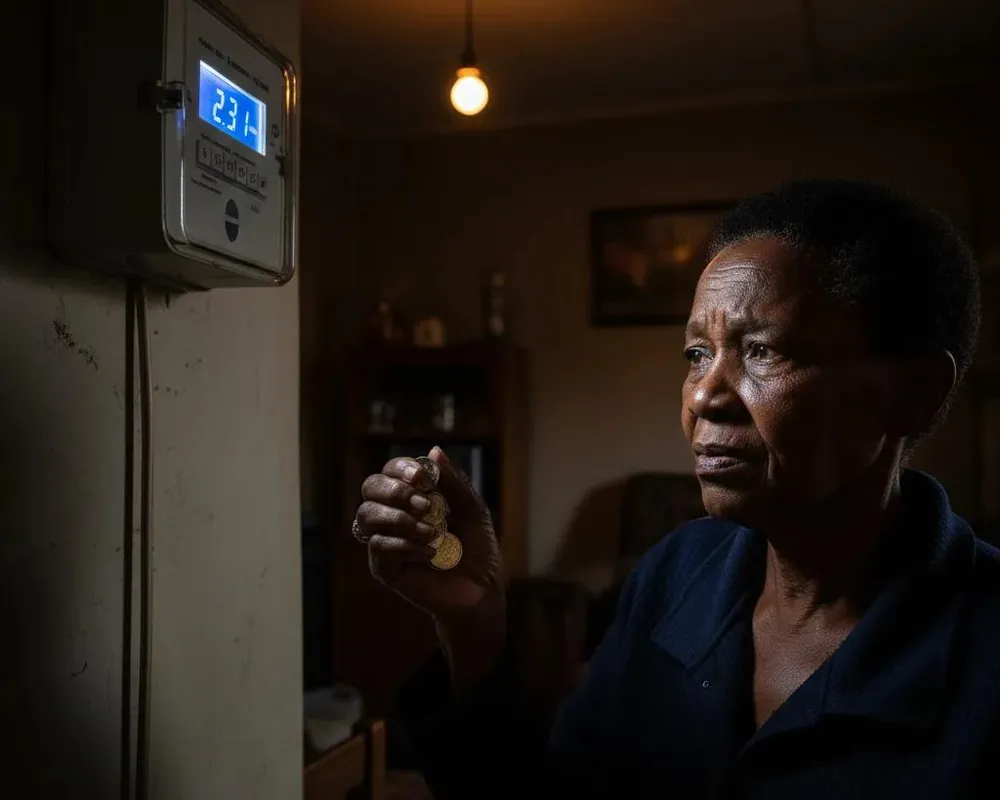
The Electricity for All campaign has called on the National Energy Regulator of South Africa (NERSA) to reject Eskom’s proposed tariff increases, warning that households already rationing electricity to make ends meet cannot afford another price hike.
NERSA’s public comment period on Eskom’s proposed 2027/28 electricity price adjustments closed last week on Friday. Members of the Electricity for All campaign submitted written comments to NERSA, representing affected households, electricity consumers and civil society organisations across South Africa. The submission calls for NERSA to reject Eskom’s proposed tariff increases and restructure the electricity system to ensure that energy is affordable, accessible and clean for all South Africans.
Eskom has asked for an 8.83% increase for direct customers from 1 April 2027 and 8.84% for municipal customers from 1 July 2027. This would lift its allowed revenue to R419 billion. The campaign’s written submission to NERSA says the proposed increases come after years of steep electricity price increases. Eskom’s average tariff has risen by more than 1,100% since 2007, far outpacing inflation.
Alia Kajee, Senior Campaigner at 350.org, said:
“Families are already making difficult choices between food and keeping the lights on. Pensioners, small business owners and working households told us the same thing: electricity runs out before the month does. Another increase will put even more pressure on households that are already having to ration electricity.”
Tshidiso, a community activist and father of two from Spooktown, Bekkersdal, spoke about the challenges of accessing affordable electricity, said:
“I am currently unemployed, and to keep my household running, I have to buy R20 worth of electricity every day. I can’t afford to buy electricity in bulk. For R20, I get about 7 units, which means I spend around R620 a month on electricity, roughly 229 kWh.
But that is not enough for my household’s basic needs. I have to be very careful about how we use electricity every day. We cook only once a day, making enough food for dinner that night and for lunch the following day. We have to make these kinds of compromises just to get by. For us, life has become about survival.
When you add it up, I can spend as much as R7,440 a year on electricity alone. That is money that could go toward other essential expenses, like my daughter’s annual daycare fees. If I could receive enough Free Basic Electricity to cover our basic household needs, it would make a huge difference. Having access to around 350 kWh of Free Basic Electricity each month would mean I could use the money I currently spend on electricity for other things my family needs.”
Members of the Electricity For All campaign say Free Basic Electricity (FBE) is not reaching people who need it. FBE is intended to provide a basic level of electricity relief to low-income households. But the campaign’s submission argues that the current system fails on both access and adequacy: millions of households that qualify do not receive FBE, while the amount provided to those who do is too small to meet basic household needs.
South Africa’s FBE policy currently provides a general allocation of 50 kWh per household per month to qualifying and indigent households, equivalent to less than 1.7 kWh per day. The campaign argues that this is wholly inadequate to meet a household’s basic electricity needs, including cooking, refrigeration, lighting and heating water. As electricity prices continue to rise, the 50 kWh allocation provides increasingly limited relief to households struggling to afford electricity.
The Electricity For All campaign is therefore calling for FBE to be expanded from 50 kWh to 350 kWh per month for low-income and indigent households. The campaign proposes funding the expanded allocation through cross-subsidies from industrial, commercial, and high-consumption users, while removing the administrative barriers that prevent millions of households from accessing FBE.
Increasing the allocation will not be enough if households cannot access it. The campaign’s submission estimates that around 8 million of the approximately 10 million households eligible for FBE do not currently receive it, citing cumbersome applications, restrictive municipal indigent registers and complex prepaid vending systems as barriers to access. The campaign is calling for automatic enrolment so qualifying households can receive FBE without these barriers.
The Electricity for All campaign is calling on NERSA to:
- Reject the proposed 8.83% increase for direct customers and 8.84% increase for municipal customers.
- Expand FBE from 50 kWh to 350 kWh per month for low-income and indigent households, funded through cross-subsidies from industrial, commercial and high-consumption users.
- Require automatic FBE enrolment for households that qualify.
- Retain the Inclining Block Tariff and cap fixed charges so that low-volume users are not disproportionately penalised, and conduct an affordability impact assessment on low-income consumers.
- Require full-cost accounting under the “polluter pays” principle in the National Environmental Management Act (NEMA), so that the public health and environmental costs of coal-fired electricity generation are accounted for in electricity pricing.
- Prioritise publicly funded renewable energy as part of a long-term strategy to reduce electricity costs and improve affordability.
The campaign argues that these environmental and health costs are not experienced equally. Its submission highlights the disproportionate burden carried by communities in Mpumalanga’s Highveld, where 12 of Eskom’s main power stations are located. It cites research from the Centre for Research on Energy and Clean Air estimating that coal-fired emissions impose approximately R42 billion a year in health costs and more than 5,000 premature deaths, with impacts concentrated in Mpumalanga, Limpopo and KwaZulu-Natal. The campaign argues that under the “polluter pays” principle, electricity prices should reflect these costs, not the communities living alongside coal-fired power stations.
Patrick Bond, a Professor at the University of Johannesburg Department of Sociology and a member of the Electricity for All Campaign, said:
“Communities living alongside South Africa’s coal-fired power stations are carrying a significant health burden that is not reflected in the price of electricity. The people who live with the pollution should not also be expected to carry the burden of rising electricity prices. If NERSA is considering the full cost of electricity, those health and environmental costs cannot be left out.”
ENDS***
For media enquiries, contact:
Boitumelo Masipa
Digital & Communications Specialist
350Africa.org
[email protected]
+27 81 452 9096
Related press releases
Rich nations must fill Loss and Damage Fund: Nepal communities ‘cannot survive on crumbs’
UK approval of Jackdaw gasfield in North Sea ignores climate, cost-of-living crisis
