Young People Deliver Intergenerational Climate Justice Manifesto in “Godzilla” March: Protect People, Not Polluters!
JAKARTA, 30 October 2026 – Marking the lead-up to the centenary of Indonesia's Youth Pledge, young people from different sectors, united in the Youth Coalition for Climate Justice, staged an action in response to the ongoing ecological crisis that is harming people across generations.
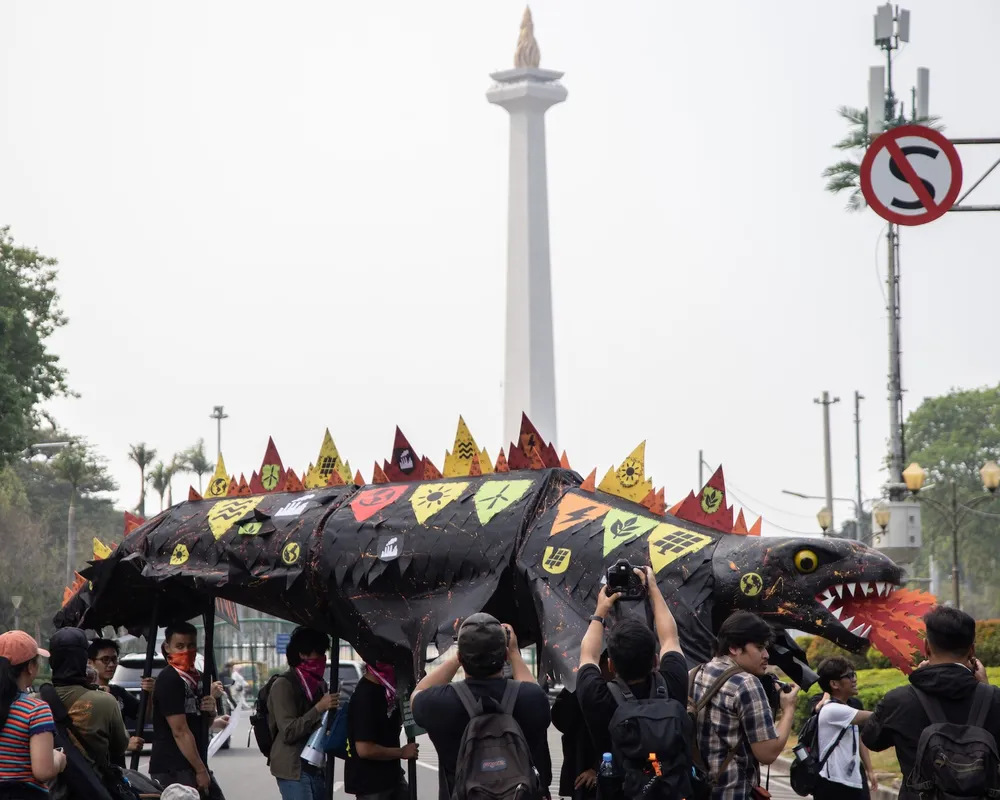
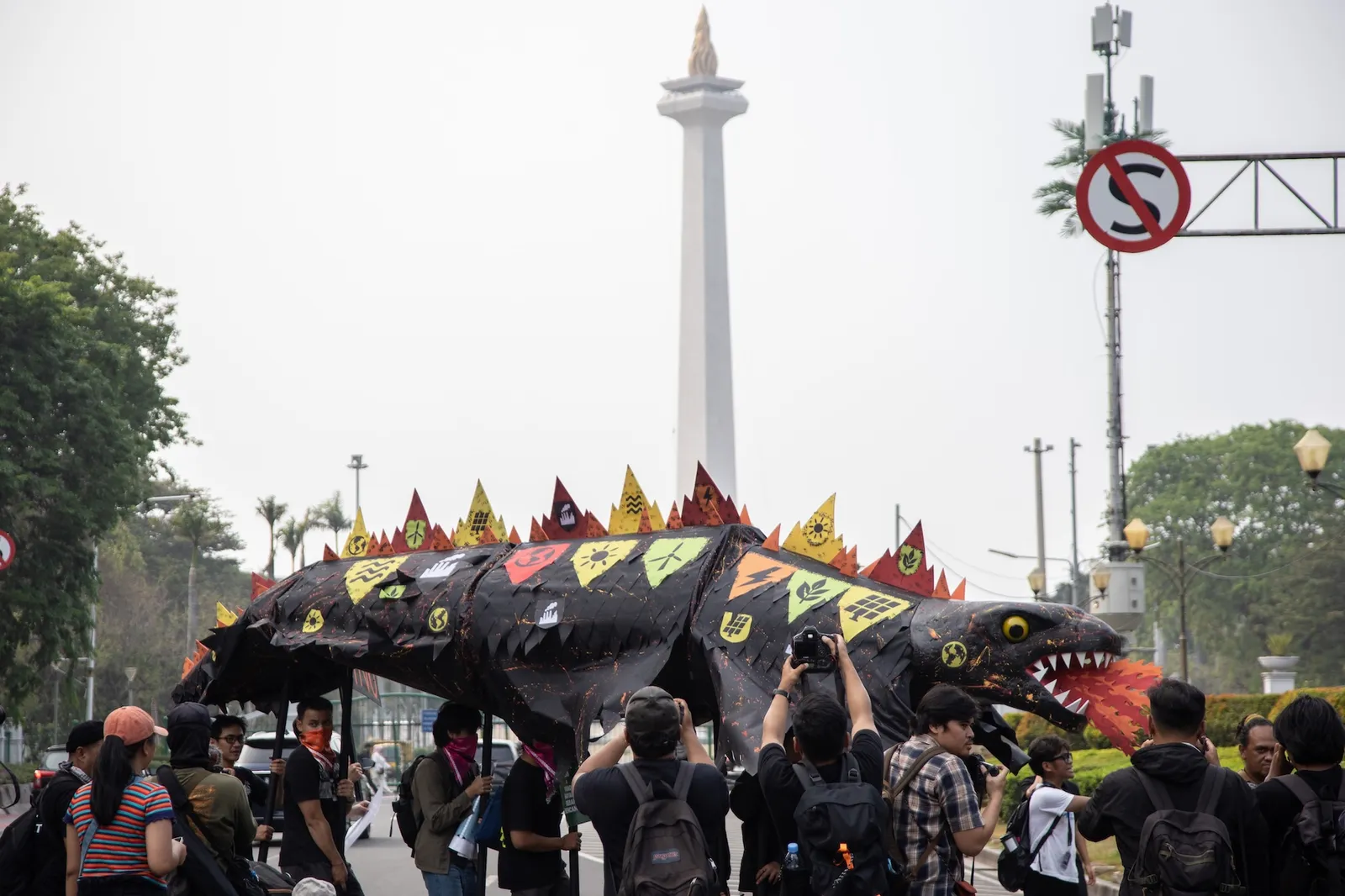
Carrying a five-metre-long monster installation called “Godzilla El Niño”, protesters marched from outside the United States Embassy towards the Patung Kuda (Horse Statue) area, where they read out the Intergenerational Climate Justice Manifesto.
Godzilla El Niño was used as a symbol of the climate crisis intertwining with natural phenomena, ultimately amplifying the severity of disasters many times over.
Protesters argued that the ecological disasters increasingly threatening people's lives across Indonesia – from smoke haze caused by forest and land fires, flash floods and droughts to the rising cost of living – are not simply natural phenomena. Rather, they are the consequences of human activity and a reckless development model driven by a combination of government political ambitions and the greed of major corporations, which place the profits of a small minority above people's safety.
The Horror of Government Policy: A Vicious Cycle of Fossil Fuel Energy and an Energy Transition That Forgets Human Rights
According to the Global Coal Plant Tracker, Global Energy Monitor (2024), captive coal-fired power plants (coal plants dedicated to industrial areas) account for almost 30% of Indonesia's total coal-fired power capacity and contribute significantly to emissions.
However, the government's continued failure to halt their operation risks trapping the country in carbon lock-in – a state of dependence on fossil fuels that slows the transition to clean energy.
Meanwhile, protesters argued that existing energy transition policies still fail to adequately address questions of justice. Renewable energy projects, such as geothermal developments, should not come at the expense of the human rights of communities affected by them.
Young People Want the Government to Fund the Future, Not the Crisis
The direction of public financing was also criticised for failing to guarantee a future in which young people are free from the climate crisis. This is reflected in the investment priorities of Danantara, the state asset and investment management institution, which continues to finance dirty energy projects.
Official reports from the Ministry of Energy and Mineral Resources (ESDM) also show that investment in Indonesia's energy sector, driven by both government policy and public-private capital, remains dominated by fossil fuels.
Of the US30.3billioninvestedintheenergyandmineralresourcessector,oilandgasaccountedforUS15.6 billion – more than half of the total. By contrast, investment in New and Renewable Energy and Energy Conservation (EBTKE) remained far behind, reaching only around US$0.8 billion in the first half of 2025.
Protesters called on the state to manage public money transparently and in the public interest, rather than using it to finance the crisis or programmes that lack urgency, serve narrow political interests and suffer from flawed implementation mechanisms, such as the Free Nutritious Meals Programme (MBG) and the Red-and-White Village Cooperatives (KDMP).
For example, MBG received a budget allocation of IDR 223 trillion in the 2026 state budget, financed at the expense of other sectors, including education and healthcare.
Workers and Affected Communities Must Be Prioritised
Protesters also highlighted how workers, Indigenous Peoples, local communities, urban neighbourhood residents, women, young people and other vulnerable groups – those most affected by development projects – are rarely meaningfully involved in climate policymaking. Their participation is often limited to formal consultations or simply one-way information sessions.
Climate policies, including the energy transition, must prioritise affected communities. No one should be left behind in the name of transition.
Protesters called for the economic benefits of the energy transition not to be concentrated in the hands of companies and investors, but to be shared with communities through decent jobs, affordable energy access, improved environmental quality and stronger local economies.
Protect People, Not Polluters
Fossil fuel companies have continued to generate enormous profits while benefiting from favourable fiscal conditions.
In the first quarter of 2026, Indonesia's major energy companies recorded substantial profit increases. PT Bukit Asam (PTBA) saw profits rise by more than 104.8% (from IDR 391.5 billion to IDR 801.79 billion), Adaro's profits increased by more than 70% (from IDR 1.27 trillion to IDR 2.16 trillion), while Indika Energy recorded a profit increase of more than 142%. Meanwhile, communities are left bearing the costs of environmental destruction.
Protesters strongly condemned this inequality, in which ordinary people continue to shoulder the burden of a crisis caused by the fossil fuel industry.
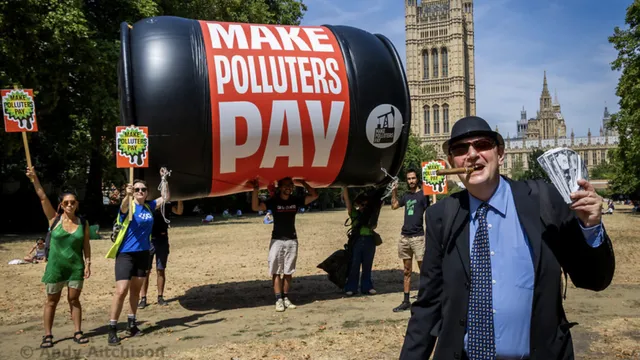
Rather than being borne by the public, the costs of the climate crisis should be paid by the companies responsible for causing it – particularly when those companies are making excessive profits from environmentally destructive activities.
To address this, protesters are calling for the introduction of a Windfall Profit Tax on fossil fuel companies as part of the broader climate justice movement, based on the Polluter Pays Principle.
Protesters also highlighted how the government uses legislation and state security forces to silence critical voices opposing land-grabbing projects carried out in the name of “development”. Rather than protecting polluters, the government should be protecting its people.
Restoring Our Relationship with the Earth
Amid an unrelenting series of ecological disasters, protesters called on the government to immediately end a development model that exploits natural resources excessively, drives deforestation and destroys ecosystems for short-term economic gain.
If the government is genuinely serious about raising its climate ambition, protesters argued, it must take a clear and firm position to ensure that its emissions reduction targets are aligned with the 1.5°C temperature limit in its Nationally Determined Contribution (NDC). This must be backed by binding policies and transparent, accountable implementation and monitoring mechanisms.
The collective action on 30 October 2026 marked a historic moment for young people reclaiming their right to a future that should be guaranteed. Young people do not want to inherit a crisis; they are uniting to shape the direction of change in their country and free it from that crisis.
The manifesto can be accessed here:
https://bit.ly/ManifestoIklimAntargenerasi
Photos and documentation of the Intergenerational Climate Justice Manifesto Action:
https://bit.ly/DokumentasiManifesto
About the Coalition
The Youth Coalition for Climate Justice is a cross-sector collective movement initiated by Climate Rangers Indonesia, Solidaritas Perempuan, the Indonesian Center of Environmental Law (ICEL), Trend Asia, Satya Bumi, Extinction Rebellion Indonesia, Kolektif Buruh Perempuan, the Indonesian Student Union (SMI), Organisasi Buruh Muslim, Komunitas Baca-Baca di Taman (KBBT), Front Perjuangan Pemuda Indonesia (FPPI), Ranita UIN Jakarta, 350 Indonesia, and various alliances of Indigenous communities and other vulnerable groups affected by the ecological crisis.
1. Climate Rangers Indonesia
Focus: Intergenerational Climate Justice
"Young people are tired of being treated merely as subjects of formal consultation in government climate policymaking. Our future must not be decided without us. The government must genuinely prioritise young people and other affected communities by providing meaningful opportunities for participation and incorporating our concerns about the burden of the climate crisis into every climate policy.
"We are not simply inheritors of the future; we also have the right to determine the direction of change."
— Muhammad Abihul Fajar, Climate Rangers Jakarta
2. 350 Indonesia
Focus: Financial Transparency and Polluter Taxation
"At a time when people are struggling with forest-fire smoke haze and the rising cost of living caused by disasters, at least three major national coal companies – PTBA, Adaro and Indika Energy – are celebrating their profits, recording increases in net profits of hundreds of per cent in the first half of the year.
"We demand that those in power immediately implement the Polluter Pays Principle through a Windfall Profit Tax, whereby the enormous profits of corporations destroying the environment must be reclaimed to fund disaster recovery and social protection for the people, rather than being allowed to flow unchecked into shareholders' pockets."
— Suriadi Darmoko, 350 Indonesia
3. Satya Bumi
Focus: Systematic Deforestation and Dirty Investment
"The recurring forest and land fires and severe flash floods across various regions are ecological disasters resulting from systematic deforestation, legitimised through pro-investment policies.
"Satya Bumi's analysis shows that 3.68 million hectares of concessions are located within Key Biodiversity Areas (KBAs), predominantly logging concessions (72%), followed by mining and palm oil plantations. Meanwhile, 157,700 hectares of natural forest were lost within KBAs over five years (2021–2025).
"Forest and land fires have continued to increase in KBA areas between May and August, threatening thousands of wild animals and human lives.
"We urge the government to stop deforestation in areas of critical importance to biodiversity, review overlapping permits, take firm action against environmentally destructive corporations, and guarantee ecosystem restoration and protection of the rights of affected communities. Forests and people's lives must not be sacrificed for investment."
— Riezcy Cecilia Dewi, Campaigner, Satya Bumi
4. Solidaritas Perempuan
Focus: Gender Justice and Impacts on Vulnerable Groups
"Every instance of environmental destruction and ecological disaster, enabled by the continued granting of permits to polluting corporations, places women and impoverished communities in the most vulnerable position when it comes to bearing the social burden.
"When livelihoods are destroyed by the climate crisis, the domestic and economic burdens on families increase dramatically, without any guarantee of protection or fair restoration of rights from the state.
"This extractive development model must be fundamentally overhauled to recognise women's sovereignty over land and water, as well as guarantee equitable, gender-responsive access to food."
— Representative of Solidaritas Perempuan
5. FPPI / Front Perjuangan Pemuda Indonesia
Focus: Budget Sovereignty and State Budget Allocation
"It is deeply troubling to see the government choosing to allocate an enormous IDR 223 trillion in the 2026 state budget to an ambitious programme serving narrow political interests, such as the Free Nutritious Meals Programme (MBG), which has demonstrably taken resources away from crucial sectors for young people's future, including education and healthcare.
"Public wealth, including state investment managed through Danantara, must be subject to open and accountable oversight directly by civil society.
"Public funds must be redirected towards meeting people's basic needs and mitigating climate disasters, rather than subsidising the political ambitions of elites."
— Riyas, Front Perjuangan Pemuda Indonesia
6. Organisasi Buruh Muslim
Focus: Workers Also Bear the Burden of the Crisis
"Who are the first victims of the destruction caused by fossil fuel companies? Workers who receive low wages in mining operations while facing safety risks and sacrificing their health, damaging their lungs as they breathe in pollution just to make a living.
"Workers! Delivery couriers, online motorcycle taxi drivers and all transport workers! Our future as workers is also being taken away by a climate crisis we did not create."
— John Castro, Organisasi Buruh Muslim
7. SMI / Serikat Mahasiswa Indonesia
Focus: Education Funding Sacrificed by Government Policy and Spending Priorities
"Rather than prioritising investment in our future through education, government policies and public spending are being directed towards the wrong priorities. They are financing the crisis, sometimes at the expense of our right to education.
"Approximately IDR 225 trillion, or around 29.01% of the entire education budget, is being used for the Free Nutritious Meals Programme (MBG).
"This funding should instead be allocated to more fundamental priorities, including improving the welfare of teachers and lecturers, increasing operational support for universities, and ensuring equal access to quality education and facilities across all regions."
— Anugerah Setiawan, Representative of the Indonesian Student Union
8. Komunitas Baca-Baca di Taman (KBBT)
Focus: Liberating Literacy and the Shrinking of Public Space
"We learn from drying land, felled trees, polluted rivers and increasingly suffocating air. From these things, we recognise one reality: there is a conspiracy between those in power, who hold the authority to issue permits, and fossil fuel corporations, which control the capital.
"They extract the profits; we bear the destruction.
"We read not to remain silent. We gather for more than simply sitting together. We learn to resist.
"The Earth does not belong to those in power or those with money. The future is not for sale!"
— Edwano, Komunitas Baca-Baca di Taman (KBBT)
Related press releases
South Africa: Communities call on Local Leaders to Pledge Support for Free Basic Electricity
Big Oil's $56.3 billion profit bonanza comes as El Niño threatens millions of lives