
It’s been weeks since I last heard from my parents. The floods that hit Indonesia last November swept away bridges, roads, and entire neighborhoods. Communication lines went down, and with them, my last direct link to home. Every day, I hold onto hope that they are safe and well.
I grew up in Aceh – a place shaped by political trauma, conflict, tsunami, and earthquakes. By the time I was 12, my house was completely destroyed once, the entire village was burned during the conflict and we had to evacuate several times. Disaster was something I didn’t choose, but had to learn to live with. What I didn’t know then was that climate change would make everything worse: heavier rains, deadlier floods, more communities displaced. What used to be “once in a lifetime” now feels like every year.
One moment that changed everything came in junior high school, when activists from Jakarta screened a short film called Turtle World. It showed monkeys living on the back of a turtle, who dies after being exploited – and their home disappears with it. That nine-minute animation sparked something in me: some people treat the Earth the same way; staying silent means losing your home; and art can open people’s eyes. That’s why today I work as an art curator focusing on environmental, gender, and social justice. Art gives us language for grief, anger, hope – and action.
My activism deepened when I joined actions with 350.org, from Rise for Climate in 2018 to Draw the Line this year. In 2021, I helped create Climate Rangers Jogja, a community of volunteers who use creativity and collective action to push for climate justice. And through 350.org, I found the support system I needed to grow into this work – from training, to mentorship, to regional and global networking opportunities that connect me with organizers from all over the world.
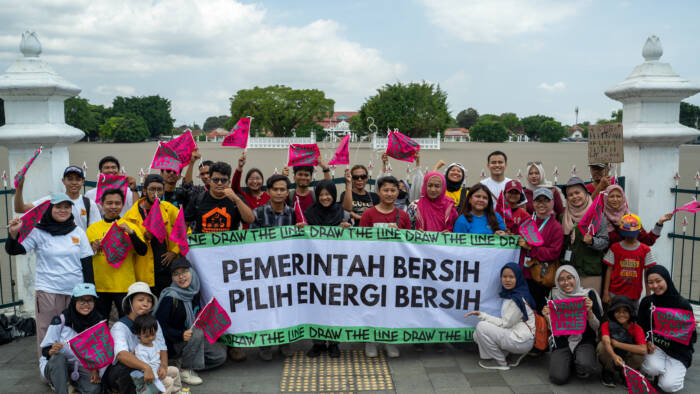
Climate Rangers Jogja at Draw the Line, September 2025
With 350 Indonesia, I’ve been part of actions that link environmental issues to politics, culture, and spirituality – and these campaigns taught me that fighting for climate justice is not only about science or policy; it’s about dignity, belonging, and the right to stay rooted in the places we love.
In Indonesia, environmental issues are never just “environmental.” They’re political, economic, social. We’re up against massive extractive industries – the kind of “organized money” that shapes laws and profits while people like my family bear the cost. Floods like the one in Aceh don’t happen in isolation, they’re fueled by deforestation, mining, and a fossil-fuel system that puts profit over human life.
That’s why we need “organized people” – communities who are awake, connected, and refusing to accept a future dictated by coal, oil, and gas companies. We need to hold these industries accountable. We need to make them pay for the chaos they’re fueling.
We deserve a world powered by wind, sun, and water – not by the destruction of our lands and futures. And until that becomes real, I’ll keep organizing, creating, and fighting for the place that raised me – alongside 350.org and my fellow Climate Rangers.
I don’t want to lose my home again. I don’t want anyone else to lose theirs either. And I invite you to join this fight with me.