
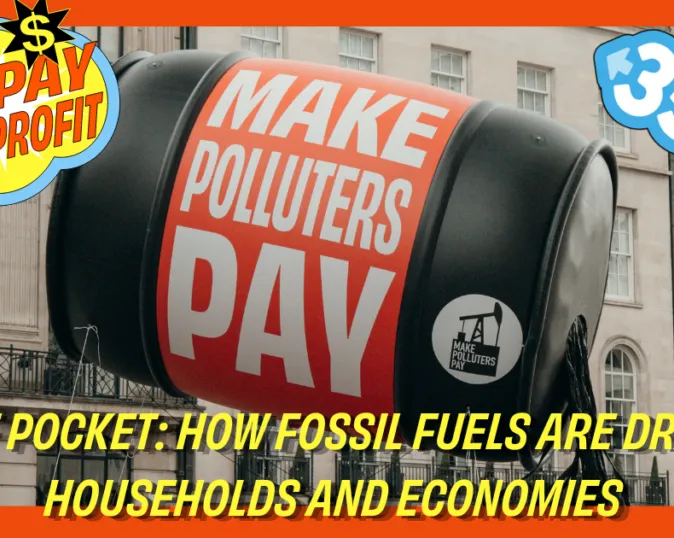
We pay, they profit
Every time fuel prices spike, governments tell households it’s a global shock beyond anyone’s control. This report tells a different story. The war in South West Asia is sending oil and gas prices to the roof and squeezing households and public finances – from Pakistan to South Africa, the United States and beyond. This is not bad luck. It is the price of a system that was designed this way, kept this way, and is making a small number of corporations extraordinarily rich while doing it.
Ordinary people are paying for fossil fuels three times over. First, through their taxes: governments funnel public money into subsidies that deliver just 8 cents of every dollar to the poorest 20% of households, while the wealthy capture most of the benefit. Second, through their bills: every time a war, an embargo, or a supply disruption sends oil prices surging, import-dependent households absorb the shock in fuel costs, food prices, and transport fares with no savings buffer and no hedge. Third, through mounting climate damages: the floods in Sindh, the droughts in Morocco, the heatwaves closing schools in East Africa are not random disasters. They are the compounding cost of decades of subsidized fossil fuel combustion — falling, disproportionately, on the same households the subsidies claimed to protect.
"As this remarkable report—the best combination of numbers and reporting on this issue I’ve ever seen—makes crystal clear, we’ve been unwise for many decades to rely on fossil fuels. That reliance has produced riches for a few, and penury for far too many; almost all of us live in the grip of a system over which we have little or no control. The price spikes and supply shocks that have come with this new war are just the latest and most profound evidence of these basic truths."
— Bill McKibben, Environmentalist, author, co-founder of Third Act and emeritus board member at 350.org
Expert takes: watch the panel discussion
The US$ 12 trillion free ride
The scale of what’s being extracted from ordinary households is far larger than governments admit. The IMF puts global fossil fuel subsidies at US$7.4 trillion in 2024. But the IMF’s climate damage figure rests on a carbon price — US$85 per tonne of CO₂ — that represents the cheapest possible price to keep warming below 2°C, not the actual damage fossil fuels cause.
Using the peer-reviewed damage models that now underpin the US Environmental Protection Agency’s official social cost of carbon, 350.org recalculated those figures for 186 countries. The result: the industry causes at least US$9.3 trillion per year in climate damages and air pollution deaths alone — and pays almost nothing for it. Add direct government subsidies and tax breaks, and the total transfer to the fossil fuel industry reaches US$12 trillion a year, including production-side subsidies tracked by the OECD— more than 60% above the IMF’s figure, equivalent to more than US$1,400 from every person on Earth, and nearly three times total global climate finance ($400 billion/year).
The fossil fuel industry knows how to profit from the very crises it creates — positioning itself to pocket massive windfall gains precisely when everyone else struggles as prices spike. US oil producers alone are set to pocket an extra US$60–63 billion in windfall profits in 2026 from the current crisis — more than double what the IEA estimates would be needed to deliver electricity and clean cooking to every person in Africa. Meanwhile, families across the Global South face fuel rationing, shortages of fertilizer, and soaring food prices. The same war. Opposite outcomes.
US$ 12 trillion: the cost of fossil fuels
This is the total annual transfer to fossil fuel industry, including the costs we pay to tackle the impacts of climate damages and pollution and amount directly paid to coal, oil and gas companies in subsidies and tax breaks. This estimate is based on 350.org’s recalculation of the IMF subsidy calculations, by applying peer-reviewed climate damage models data from 186 countries.
US$ 1,400 per person, per year
This is the equivalent per-capita cost of the $12 trillion annual transfer to the fossil fuel industry per year. Which means: this is how much we all individually pay, in average.
8 cents goes to the poorest
This is the amount received by the poorest 20% of households from every dollar spent on fossil fuel subsidies. The wealthy capture the rest.
The solution is not complicated. It requires political will.
There is nothing inevitable about life in the dire straits of fossil fuel dependence. The spiralling household bills, faltering insurance markets and farms and homes washed away or baked dry are not the unavoidable price of “keeping the lights on”; they are the cumulative cost of clinging to an energy system that no longer works for most people. Decades of delay have turned every oil price spike into a household emergency and every climate‑fuelled disaster into another withdrawal from the savings of the world’s poorest communities, narrowing the margin for error with each passing year.
Exiting the dire straits of a fossil‑powered world is therefore less a leap into uncharted waters than a decision to follow channels that are already visible on the map. The safest passage lies in scaling up those people‑powered solutions and aligning global finance, industrial policy and governance with their logic. That means redirecting fossil fuel subsidies, making major polluters pay, and recycling revenues, including from windfall taxes, into clean energy access, electrification of demand, social protection and just‑transition measures that shield workers and communities.
As part of emergency plans, governments should:
- Direct additional tax revenues linked with higher fuel prices into targeted cash support and mass clean‑energy programs for the poorest households and for SMEs (solar home systems, clean cookstoves, e‑two‑wheelers, efficient public transport) instead of across‑the‑board petrol and diesel price controls or subsidies.
- Implement windfall taxes on fossil fuel companies and other sectors profiting from the current crisis
- Fast‑track investment in resilient, people‑centred grids and distributed renewables by simplifying permitting, de‑risking projects with guarantees, and prioritising community‑owned or municipal solar, wind and storage.
- Leverage the crisis in international negotiations to demand and channel concessional finance, debt swaps and loss‑and‑damage funds into just transition plans that create decent green jobs and support workers and communities currently dependent on fossil fuel value chains.
Tell the EU Commission:
Stop Making People Pay for Fossil Fuels
It’s high time our governments stopped allowing fossil fuel companies to rake in outrageous profits while we end up paying out of pocket.
You can also contact your national and local representatives. Download the report, and email or deliver it directly to them.
